
25 TikTok Video Ideas That Go Viral in 2026 (With Scripts)
Updated: June 2026
The reason most creators burn out on TikTok is not a lack of creativity. It's that they treat every video as a blank canvas that needs a completely original idea. That pressure compounds daily until posting feels impossible.
Here's what the top creators in finance, fitness, tech, and beauty are actually doing: they use five or six structural frameworks on repeat and swap the topic inside the framework. The format stays the same. The niche knowledge changes. If you study the accounts growing the fastest right now, the pattern becomes obvious within minutes.
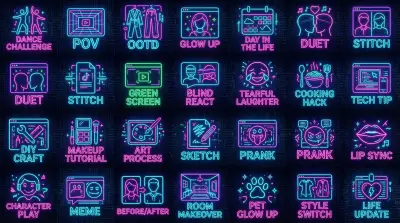
You don't need 365 unique ideas to grow on TikTok. You need a small set of proven, high-retention formats you can run indefinitely. These 25 video frameworks are divided into five content pillars that consistently drive views across niches. For context on why these formats perform, it helps to understand how the TikTok algorithm distributes content.
Pillar 1: The Negative Hook Educational Format
People are more motivated to avoid a loss than to chase a gain. "How to grow a plant" gets 5,000 views. "3 mistakes that are killing your plant" gets 500,000. That gap is not an accident. Negative framing creates immediate, personal stakes. The viewer has to keep watching to find out if they're the one making the mistake.
1. The "Stop Doing This" Warning
Hook: "If you are doing [common action], stop immediately."
Cut straight to the explanation after the hook. No introduction. No "hey guys." The viewer clicked because of the warning, and if you delay the payoff by even five seconds, they're gone. This format works because it creates instant self-audit. The audience watches to see if they're guilty.
2. The "Secret They Don't Tell You" Reveal
Hook: "This is the one thing [industry] doesn't want you to know."
The script needs a genuinely specific tip, not a vague one. A real example: "The supplement industry doesn't want you to know that generic creatine monohydrate is the same compound as the $60 premium brand." Specific, verifiable, slightly uncomfortable for someone in that industry. That's the target. Vague "secrets" kill this format immediately.
3. The "Worst Purchase" Confessional
Hook: "The worst $[amount] I ever spent on my [hobby or business]."
Product reviews are forgettable. Product warnings are shareable. People watch to avoid making the same mistake, and they send it to friends who are about to buy the same thing. The save and share rates on this format are consistently high across niches.
4. The "Why You're Failing" Diagnosis
Hook: "The real reason your [goal] isn't working."
This works best when you name a specific, non-obvious reason rather than a generic one. "You're not posting enough" is a useless hook. "Your hook length is 3 seconds too long and that's why the algorithm is killing your videos" is specific enough to make someone stop scrolling.
5. The "Delete This App" Direct Command
Hook: "Delete [popular tool] and use this free alternative instead."
Name the tool in the hook. This format pulls in existing audiences for both the tool you're criticising and the alternative you're recommending, which gives you two search audiences at once.
Pillar 2: The Identity and Relatability Format
These videos are built to be shared, not just watched. The goal is a WhatsApp forward or a comment tag. They don't teach anything. They hold up a mirror to a specific group of people, and if the specificity is right, that group sends it to everyone they know.
6. The Hyper-Specific POV
Hook (text on screen): "POV: You are the eldest daughter in a Desi household."
The more specific the demographic, the harder it lands. Broad POVs ("POV: You're tired") get skipped. Tight POVs that name a real, recognisable slice of identity get shared inside that community at a rate that's hard to replicate with any other format.
7. The "Things That Make Sense" Tour
Hook: "Things in my [location] that just make sense."
Rapidly move the camera around showing unusual, funny, or intensely practical things in your space. The fast pacing drives replays and the format invites comments from people who relate to specific items you show.
8. The "What People Think vs. Reality" Contrast
Show three seconds of the glamorous assumption, then cut to ten seconds of the chaotic reality. "What people think running a business looks like" followed by footage of you spreadsheet-panicking at midnight. The contrast is the entire joke and the entire point. No narration needed.
9. The Unpopular Opinion Debate Starter
Hook: "Here is my most unpopular opinion about [niche]."
State a position that's defensible but genuinely contested in your space. The comments will do the rest. This format's performance is almost entirely driven by comment volume, which TikTok reads as a strong engagement signal.
10. The "Types of People" Taxonomy
Act out three recognisable stereotypes in your niche. "The three types of guys at every gym" or "every type of client I've ever had." You play all three. The production is simple and the format rewards anyone who belongs to one of the categories to tag someone who belongs to another.
Pillar 3: The Authority and Proof Format
Views don't convert to followers unless people believe you know what you're talking about. These formats are specifically for building that trust. They take longer to produce than a hook-and-cut video, but they're what actually grows an account over months rather than one viral spike.
11. The Raw "Day in the Life"
Hook: "A realistic, unfiltered day in the life of a [job title]."
Polished aesthetic vlogs have been declining in performance for a while. The accounts that are growing on this format now are showing real failures alongside real wins. The messier and more honest the better. Credibility comes from showing what goes wrong, not just what goes right.
12. The Behind-the-Scenes Process Breakdown
Time-lapse yourself completing a complex task, then use voiceover to explain the decisions you made along the way. Painting a piece, writing a strategy, building a website. The time-lapse visually proves the work happened. The voiceover provides the expertise layer.
13. The Transformation Timeline
Hook: "How I went from [low point] to [result] in exactly [timeframe]."
Three things need to be in the script: proof of the low point, proof of the result, and the specific steps in between. Skip any of those three and it reads as fabricated. The proof is what makes this format land as authority rather than as a flex.
14. The "Reacting to Bad Advice" Duel
Use the green screen effect to put another creator's video in the background. Pause it at a specific claim, then explain exactly why that claim is wrong. Keep it professional and specific. Attacking vaguely looks defensive. Correcting a specific technical error looks like expertise.
15. The Tool Stack Reveal
Hook: "The exact tools I use to run my entire [business or workflow]."
People search for this constantly. Name real tools, give honest opinions on each one, and include at least one non-obvious recommendation. Lists of the five most popular tools in any niche already exist everywhere. The non-obvious pick is what makes yours worth saving.
Pillar 4: The High-Utility Save-Bait Format
TikTok's algorithm treats saves as one of its strongest quality signals. A video with a high save rate gets pushed into search results and held there longer than almost any other metric can achieve. These formats are built to be bookmarked.
16. The Screenshottable Checklist
Point to a literal list on screen and say: "Screenshot this before your next [trip/project/purchase]."
The instruction to screenshot is important. It tells the viewer exactly what action to take, which dramatically increases the rate at which they do it. Dense, specific lists outperform short generic ones on this format.
17. The Hidden Website Series
Hook: "Websites that feel illegal to know about (Part [number])."
Screen-record a genuinely useful free tool or resource while narrating what it does. The "illegal-feeling" framing is somewhat tired now, so the tool itself needs to earn the reaction. Find something that genuinely surprises you and the framing takes care of itself. This format generates shares at a rate that most other formats don't come close to.
18. The Micro-Tutorial Fast Guide
Hook: "How to [specific task] in under [short time]."
The pacing should be fast enough that most viewers need to watch it two or three times to catch every step. Those replays count as watch time loops in TikTok's metrics, which signals strong retention. Keep each step visible for about two seconds and let the speed do the work.
19. The Financial Reality Breakdown
Hook: "Exactly how much it costs to live in [city] in 2026."
Specific city, specific year, specific numbers. This format works because people search for it directly, save it for reference, and share it with people considering a move. The more granular the line items, the better it performs.
20. The "Plain English" Definition
Take a complex industry term and explain it using a physical analogy. "What actually is a marketing funnel?" explained by literally pouring water through a plastic funnel on camera. The visual makes it memorable and the simplicity makes it shareable to anyone who's been too embarrassed to admit they don't know what the term means.
Pillar 5: The Community Interaction Format
Accounts that stay at 10,000 to 50,000 followers for months are usually broadcasting, not conversing. These formats turn passive viewers into people who feel like they're part of something. That shift is what drives the follower conversions that compound over time. For more on why most TikTok accounts stall at this stage, see why most TikTok creators fail to grow past their first plateau.
21. The Video Reply Deep Dive
Reply to a specific, thoughtful, or contentious comment with a dedicated 60-second video. The commenter gets notified and almost always watches and comments again. That thread then attracts everyone else who commented on the original video. One reply video can extend the life of a post by weeks.
22. The Rapid-Fire Q&A
Hook: "Answering your top 5 questions about [topic] in 60 seconds."
Pull real questions from your comments, not invented ones. Real questions have a different texture than made-up ones and your audience will notice the difference immediately. Answer each one in ten seconds or less, then cut.
23. The "Help Me Choose" Poll
Hold up two real options and genuinely ask your audience to pick. Two thumbnail designs. Two product colorways. Two outline directions for your next video. The comment section will divide into camps and argue, which drives the video onto more For You Pages without any additional effort on your part.
24. The Challenge Invitation
Hook: "I challenge you to try this for 7 days."
State the challenge clearly, give the exact rule, and ask people to report back in the comments. The follow-up reply videos practically write themselves. This format creates content momentum across multiple videos from a single initial post.
25. The Storytime Authentic Ramble
Hook: "The strangest thing just happened with a client..."
Keep the story structured. A real beginning, a specific middle, and a twist that pays off the hook. Human attention tracks narrative instinctively. The "authentic ramble" label is misleading. The best storytimes are tightly scripted to feel unscripted, with the twist held until the last possible second.
How to Avoid Format Fatigue
Don't run the same pillar five days in a row. Five consecutive negative-hook videos and your account starts to feel exhausting to follow. A simple weekly rotation keeps the feed varied without requiring you to invent anything new:
Post a negative hook video on Monday to drive shares. A proof-based authority video midweek to build trust. A save-bait tutorial at the end of the week to build search traffic. That three-type rotation covers the three most important distribution mechanisms TikTok uses and keeps each video from cannibalising the last.
Frequently Asked Questions
- Can I reuse the exact same script structure for a different topic?
- Yes, and the best creators do this constantly. If a video called "3 mistakes you're making with your iPhone" gets a million views, the next logical video is "3 mistakes you're making with your Mac" using the same pacing, hook structure, and camera framing. The framework is the repeatable asset. The topic is just what fills it each time.
- How long should TikTok videos be in 2026?
- Edit to the length the content actually needs, not to a target duration. Save-bait tutorials perform best at 15 to 20 seconds because the pacing forces replays. Storytimes hold attention best at 45 to 60 seconds. If you are aiming for the Creator Rewards Program, videos need to be at least one minute long, but don't pad a 30-second idea to hit that threshold. Padded videos hurt average watch time and that hurts distribution more than the reward program helps revenue.
- Why do some video ideas go viral in one niche but fail completely in another?
- The framework transfers but the audience expectation doesn't always. A "worst purchase" confessional lands hard in tech and beauty, where purchases are common and expensive. It falls flat in niches where the audience hasn't spent money on anything related to the topic yet. Before running any format, check whether your specific audience has the experience the hook is targeting. If they don't, the hook creates no personal stakes and they swipe past.
Related Articles
Explore the TikTok Growth hub →
How to Go Viral on TikTok in Pakistan
A localized system for Pakistani creators to go viral on TikTok: the content formula, niche picks, posting times, and the 30-day consistency rule.
How to Rank Videos on TikTok Search (Technical SEO Meta-Guide 2026)
A technical dive into TikTok's search engine indexing. Learn exact placement strategies for on-screen text, closed captions, and metadata.
The Ultimate TikTok SEO Guide for 2026 (How to Actually Rank)
Master TikTok SEO in 2026 without guessing. Discover the exact ranking factors, keyword strategies, and optimization methods that push your videos to the top.