
Deep Work vs Shallow Work: How to Focus in a Distracted World

Picture this: you sit down at your desk at 10 AM, laptop open, tabs ready. Four hours later it's 2 PM and you've replied to emails, skimmed three Notion pages, hopped on a Slack thread, watched two "research" YouTube videos, and technically written two paragraphs. You feel spent. You also feel like you got nothing done. That's because you didn't. Researchers call what just happened attention residue. Every time you switch tasks, a fragment of your attention stays stuck on the last thing. By the time you've switched five times, your brain is running five partial threads simultaneously, which is why four hours at a desk produces maybe 45 minutes of real output.
Most people think focus means sitting still without their phone. It doesn't. Deep work, a term Cal Newport defined precisely in his 2016 book, is cognitively demanding professional activity performed without distraction. It's work that pushes you to your cognitive limit and produces something hard to replicate. Writing a solid first draft, building a complex feature, designing a client strategy from scratch. Replying to DMs is not deep work. Neither is reformatting a spreadsheet, attending a check-in call, or refreshing your analytics dashboard.
What follows covers the actual difference between deep and shallow work, the neuroscience of why distraction costs more than it looks, four philosophies for structuring deep work around a real schedule, and a session setup you can run tomorrow. No theory left hanging without an application.
The Core Difference Between Deep Work and Shallow Work
Cal Newport's Definition and Why It Matters in 2026
Newport's definition is specific: professional activities performed in a state of distraction-free concentration that push your cognitive capabilities to their limit. These efforts create new value, build your skills, and are hard for someone else to replicate. Shallow work is logistical, often inbox-driven, and can be done while distracted without meaningful loss.
In 2026, the shallow work problem has gotten worse. The platforms freelancers and creators depend on, Instagram, TikTok, YouTube, email, Slack, Discord, are built to interrupt. Every notification is a context switch. Every tab is a competing demand on your prefrontal cortex. Newport's central argument was that deep work capacity is growing rarer while its economic value keeps climbing. That spread is not narrowing.
Examples of Deep Work vs Shallow Work for Creators and Students
Content creators: writing a detailed video script is deep work. Answering comments is shallow. Editing with intentional pacing decisions is deep. Scheduling posts is shallow. For a freelancer: writing copy from a brief, building a brand strategy, doing genuine competitive research. All deep. Updating your Notion board, replying to client check-ins, invoicing. All shallow. For a tech student: working through a new algorithm without looking at the solution is deep. Watching a tutorial at 1.5x speed is mostly shallow. Writing your own version of a project once you understand the concept is deep.
Neither category is inherently bad. Shallow work gets done because it has to. The problem is that most people's ratio is inverted. They spend 80% of their time in shallow mode and then can't figure out why they feel stuck despite being constantly busy.
Why Shallow Work Feels Productive but Produces Almost Nothing
Shallow work triggers small dopamine hits. Sending an email and getting a reply feels like progress. Clearing notifications feels like accomplishment. Ticking items off a task list generates satisfaction even when the items were trivial. Your brain does not distinguish between actual output and the sensation of activity. This is why people default to shallow work under pressure. It's faster and the feedback is immediate. Deep work feels slow and frustrating, especially in the first 20 minutes of a session. That friction is the signal that something hard enough to matter is happening.
The Science of Attention Residue and Context Switching
What Attention Residue Actually Does to Your Cognitive Output
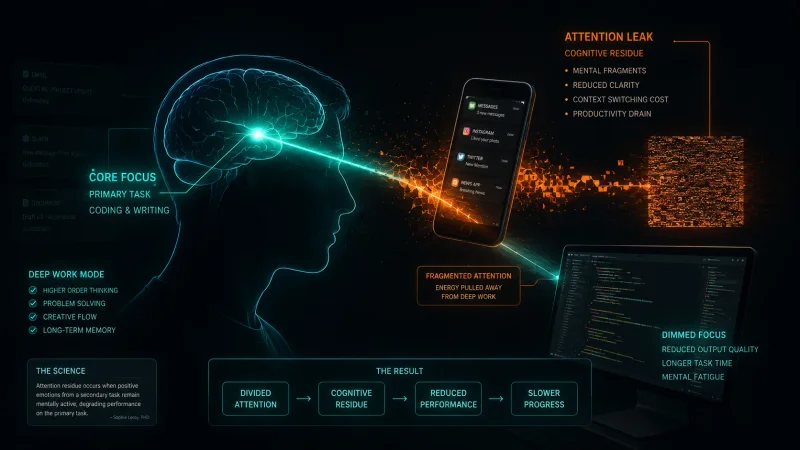
Sophie Leroy, a business professor at the University of Washington, ran a series of experiments on task-switching and coined the term attention residue. Her finding: when you switch from Task A to Task B before finishing Task A, part of your attention remains on Task A. The more urgent or unresolved Task A feels, the more attention stays behind. This is not metaphor. It shows up as measurable reduction in performance on Task B.
In practice: you're writing a client proposal and check your phone, then open email, then answer a quick Slack message. By the time you return to the proposal, your brain is still processing the email and the Slack thread. Your sentences come slower. Your thinking is shallower. You produce weaker work than if you'd never switched at all.
How Notifications and Tab Switching Fragment Your Focus Window
A study from UC Irvine found it takes an average of 23 minutes to fully regain focus after an interruption. Not 23 seconds. Not 2 minutes. Twenty-three. Four interruptions in a work session means you spent roughly an hour and a half just recovering. A two-hour session with four interruptions produces less actual output than a 45-minute session with none.
Tab switching does the same thing without the social element. Opening your email between paragraphs is an interruption. Every time you open a new tab "just to check," you're adding a partial task to your attention stack. Your browser won't tell you the cost. Your word count will.
The Real Cost of a Single Phone Check During a Work Session
The check itself takes 30 seconds. The attention recovery takes up to 23 minutes. But most phone checks don't stay at 30 seconds. You check a notification, the app opens, something mildly interesting appears, you scroll, seven minutes pass. Then comes the guilt, which is itself a cognitive load. By the time you're back at your work, the focus window for that session may be gone.
The solution is not willpower. Willpower runs out. The solution is physical separation. Phone in another room during deep work blocks, not face down on the desk.
The Four Deep Work Philosophies — Pick One That Fits Your Life
Newport describes four ways people actually integrate deep work into a real schedule. None is objectively better. The right one depends on your work structure, obligations, and what you have control over.
The Monastic Philosophy: Total Digital Isolation
The monastic approach means eliminating or radically cutting shallow obligations so you can spend nearly all your time on deep work. Newport's example is Donald Knuth, the computer scientist who famously abandoned email entirely because the cognitive overhead wasn't worth it for the kind of work he was doing. This philosophy works if your professional standing means your primary value is the depth of your output, not your responsiveness.
For most freelancers and students, full monasticism isn't realistic. Clients need replies. Deadlines require coordination. A partial version, protecting specific days or mornings as completely offline, is achievable and already a major upgrade from the default.
The Bimodal Philosophy: Alternating Deep and Shallow Blocks
Bimodal practitioners divide their time into distinct periods of deep and shallow work, with each period long enough to actually matter. Carl Jung reportedly retreated to a stone tower in Bollingen, Switzerland, for weeks at a time to write. Back in Zurich: normal professional life. In the tower: nothing else.
For a freelancer, this might look like Monday through Wednesday as deep work days (minimal email, no calls before noon) and Thursday through Friday as client communication and admin days. This is workable if you have schedule autonomy, which many freelancers and independent contractors do, at least in theory.
The Rhythmic Philosophy: Fixed Daily Deep Work Schedules
The rhythmic approach is the most accessible for most people. You pick a fixed time every day for deep work and protect it. 6 AM to 8 AM, daily, no debate. The advantage is that it removes the daily decision. The session is already scheduled, so willpower barely enters it.
This suits freelancers with recurring client work, students with daily coursework, and remote workers who have some control over when their day starts. If you struggle to do deep work because you can never quite find the right moment, the rhythmic philosophy solves that problem specifically. The moment is fixed in advance.
The Journalistic Philosophy: Deep Work On Demand
Newport named this after journalists who can shift into full concentration quickly because their work requires it. The journalistic approach means inserting deep work sessions wherever gaps appear in your schedule. No fixed rhythm, just the trained capacity to drop into deep mode when time opens up.
This is the hardest philosophy to execute and the worst one to start with. It requires an already-trained focus capacity so you can reach depth within a few minutes. If you're new to deep work, it takes 15 to 20 minutes just to properly settle. If your session is only 45 minutes, you've burned a third of it warming up. Journalistic deep work is for people who've been practicing long enough that depth is accessible fast.
Who should use what: Freelancers and content creators with schedule autonomy should start with the rhythmic approach, daily fixed sessions, and move toward bimodal as the practice matures. Students with variable class schedules do well with rhythmic early-morning blocks. Remote workers with meeting-heavy calendars often need bimodal, deep mornings and shallow afternoons, because they can't protect daily blocks reliably.
Building Your First Deep Work Session From Scratch
Choosing the Right Duration: 60 to 90 Minute Focus Blocks
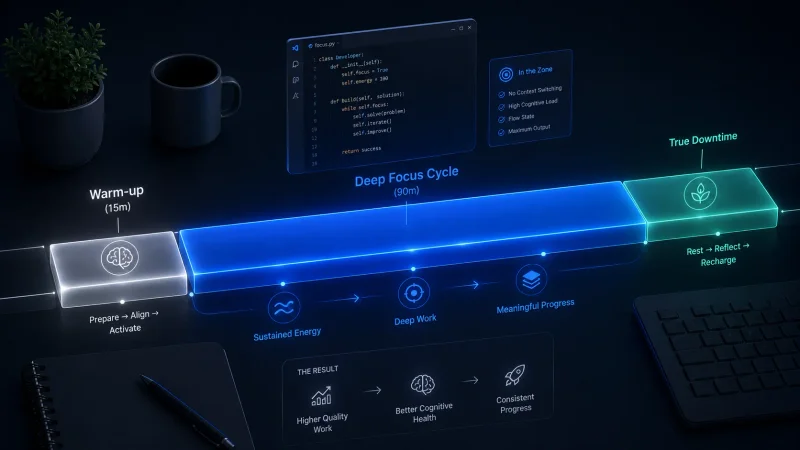
Newport recommends starting with 1-hour blocks and working up. There's nothing magical about 90 minutes, but it aligns roughly with ultradian rhythms, the 90-minute cycles your brain moves through during the day. Beyond 90 minutes, cognitive performance drops meaningfully unless you're experienced and well-rested.
For your first week: one 60-minute deep work block per day. That's it. One hour of genuine distraction-free work will outproduce three hours of fragmented shallow sessions. After two weeks of consistent 60-minute blocks, extend to 90. Don't try for four hours on day one. You'll hit a wall at minute 25, decide you're not a "focused person," and that will be the wrong conclusion. You just ran further than your current training allows.
Eliminating the Four Categories of Distraction Before You Start
Before a session, clear four categories:
Digital interruptions. Phone in another room, not face down, not on silent. Another room. All non-essential notifications off, browser tabs closed except what the session requires.
Environmental interruptions. Tell anyone who might interrupt you that you're unavailable for the next hour. Use headphones or close a door. If your home is chaotic, use time instead of space. Early morning before others wake up is often the most reliably quiet window available.
Internal interruptions. Keep a notepad beside you. When a thought surfaces, "I need to reply to that email," "did I pay that bill," write it down and return to the task. Don't act on it. The notepad offloads it from working memory without requiring a context switch.
Task ambiguity. Before starting, write one sentence defining what you're doing and what "done" looks like for the session. "Write 600 words of Section 2 of the client article" is a usable target. "Work on the article" is not. Ambiguity forces your brain to repeatedly re-evaluate what it should be doing, which kills concentration without you noticing.
The Shutdown Ritual: How to Properly End a Deep Work Session
Most people end a work session by just stopping. This leaves open loops in your brain that generate low-level background anxiety for the rest of the day. Newport recommends a shutdown ritual: a brief, consistent sequence that signals to your brain the work is contained.
A simple version: review your task list and move anything undone to tomorrow's plan (two minutes). Check email once and note anything requiring action (three minutes). Then say out loud, actually say it, "shutdown complete." This sounds odd but it works. It creates a cognitive marker that separates work time from rest time, which improves both.
Training Your Brain to Tolerate Boredom and Resist Distraction
Why Boredom Tolerance Is a Skill You Have to Build Deliberately
The reason most people can't do deep work is not lack of discipline. It's that their brains have been trained to demand stimulation constantly. Three years of reaching for your phone every time you feel slightly bored means your tolerance for low-stimulation states is near zero. Your brain has learned that discomfort is a signal to check something.
Deep work requires the opposite capacity: sitting with mental friction and slow progress without reaching for relief. This is trainable, but it has to be trained the same way any skill gets built, gradually and deliberately, with consistent exposure to what's difficult.
Newport's prescription: let yourself be bored. Don't fill every idle moment with your phone. Wait in line without scrolling. Sit in a queue without opening an app. This sounds trivial. It's not. It's building the same tolerance you need to stay in a difficult cognitive task when it gets uncomfortable at minute 18.
The Productive Meditation Technique for Commutes and Walks
If you commute, walk, or do anything that occupies your body but not your mind, you have a free focus training tool. Instead of putting on a podcast, spend the commute working on one real professional problem. Hold it in your head. When your mind wanders, and it will, bring it back. Newport calls this productive meditation.
Twenty minutes of this done consistently is genuine concentration training. It also tends to produce actual breakthroughs. Walking engages the default mode network in a way that aids insight, which is why a lot of people's best ideas come during movement rather than at a desk.
Scheduling Internet Use Instead of Scheduling Internet Breaks
Most productivity advice tells you to take internet breaks: do focused work, then reward yourself with a few minutes online. Newport argues this is backward. Instead, schedule when you go online and treat everything outside those windows as offline time.
If your deep work block is 9 to 11 AM, your next internet window might be noon to 12:30 PM. Outside those windows, you don't go online. Not to "quickly check" something. Not for one minute. The point is not that the internet is bad. The point is that every time you resist the pull to check, you're strengthening the same capacity you need to stay in hard work when it gets difficult.
For anyone rebuilding their relationship with distraction from scratch, running a low dopamine morning routine alongside a deep work practice compounds the effect quickly. The two work on the same underlying problem.
Applying Deep Work Principles to Freelancing and Content Creation
Batching Client Communication into Shallow Work Time Blocks
If you reply to client messages whenever they arrive, you're in perpetual shallow mode. Every message is an interruption. Every reply costs more than the 90 seconds it takes to send. Instead, batch all client communication into two dedicated blocks per day. For most freelancing work, 9:30 to 10 AM and 4 to 4:30 PM covers everything without sacrificing the deeper morning hours.
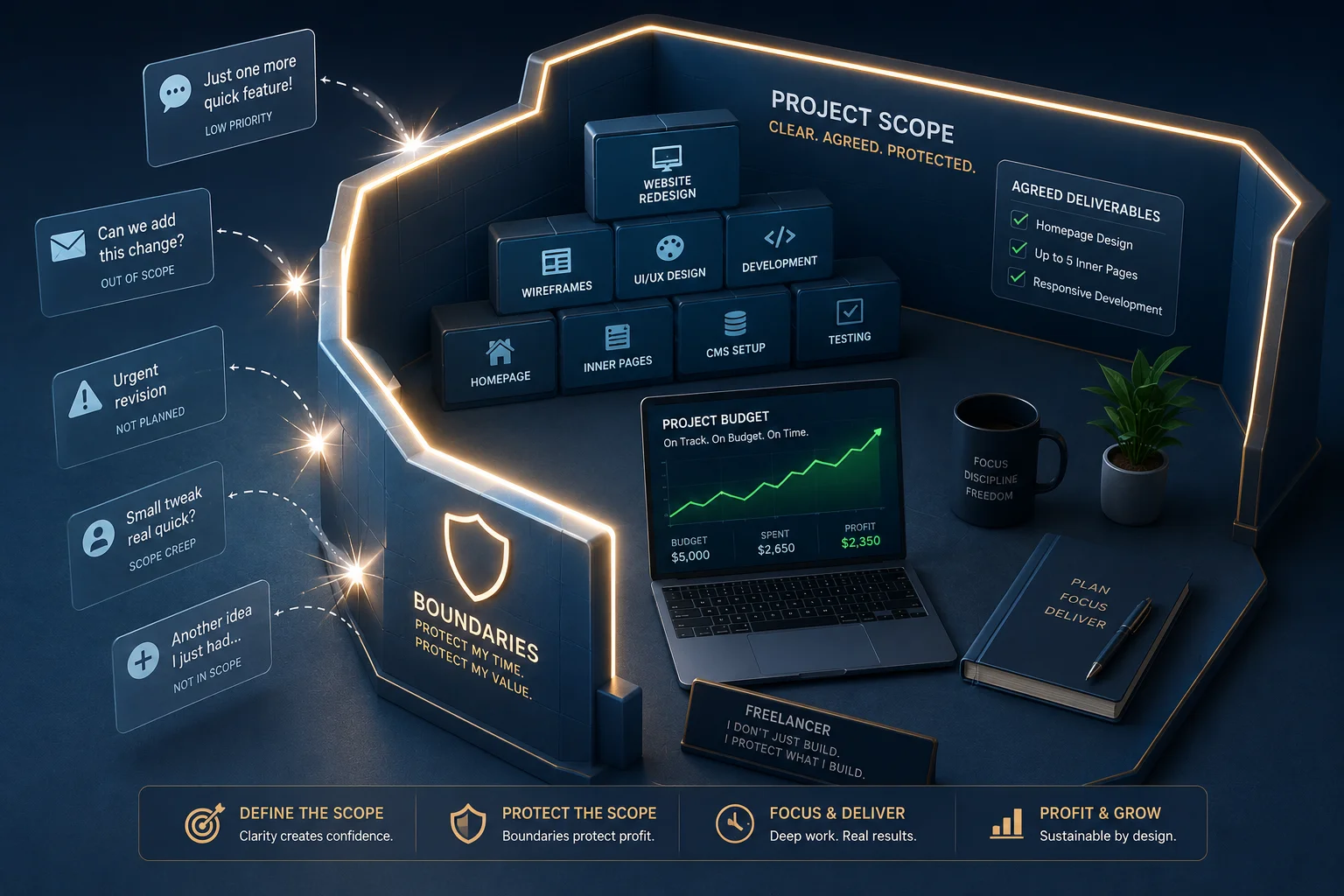
Tell clients you check messages twice daily and respond within a few hours. Most don't need immediate replies. The ones who do are telling you something useful about what that working relationship will look like long-term. Constant availability requests and scope creep usually start at the same place: no clear boundary around responsiveness.
Structuring a Deep Work Week Around Content Production Goals
Before the week starts, identify the outputs that actually require deep work. Not the tasks. The outputs. "Write three newsletter editions" is an output. "Do newsletter work" is not. Once you know your outputs, work backward: how many 90-minute sessions does each one require? Block those sessions first. Everything else, meetings, admin, calls, fills the remaining space.
This means your deep work calendar drives your schedule, not the reverse. Most content creators do this backward. They fill the calendar with reactive obligations first and then look for leftover time to do the work that actually matters. The leftover time never comes.
Measuring Deep Work Hours Instead of Total Hours Worked
Stop tracking total hours worked. Start tracking deep work hours completed. A day with 10 hours at the desk and zero deep work hours is a bad day regardless of how busy it felt. A day with four hours at the desk and two and a half deep work hours is a good one.
Newport keeps a physical tally of deep work hours and tracks them against a weekly target. The tracking changes behavior: you become more protective of sessions when you're watching the count. For anyone building an output-based identity around what they produce, this shift from tracking time to tracking depth is one of the most concrete changes available.
Frequently Asked Questions
- What is the difference between deep work and flow state?
- Flow state is an experience, the feeling of complete absorption in a task. Deep work is a practice, a deliberately structured approach to hard cognitive work done without distraction. You can do deep work without ever entering flow. Flow sometimes happens during shallow work too, though rarely. The overlap is real but they're not the same thing. Deep work creates conditions where flow is more likely, but waiting for flow before starting is backwards. Start the work. Flow occasionally follows.
- How long does it take to build a deep work habit from scratch?
- Most people notice a real improvement in their concentration capacity within two to three weeks of consistent daily sessions. Building a habit that doesn't require active willpower to maintain takes longer, typically six to eight weeks. The first week is the hardest. Sessions feel short, focus feels fragile, distraction feels constant. That's normal. Week two is easier than week one. Week four is easier than week two. It's a training curve, not a switch.
- Can I do deep work if I have a job that requires constant availability?
- Yes, but you have to test the actual expectation rather than assume it. Most "constant availability" norms are softer than they feel. People expect a reply within an hour, not five minutes. Try carving out one 60 to 90 minute block per day where you're genuinely unreachable and see what happens. Usually: nothing. If your job genuinely requires immediate response all day, the bimodal approach, protecting one or two deep work days per week rather than daily sessions, is more realistic than trying to protect daily blocks.
- Is listening to music during deep work sessions productive or harmful?
- It depends on the task. Research suggests lyric-free music at moderate volume has a neutral to slight positive effect on concentration for some people. Lyrical music activates language processing in the brain, which competes directly with reading and writing. For tasks involving numbers, visual design, or pattern recognition, it's less disruptive. The practical answer: run four sessions with music and four without, track your output quality, and trust what the data shows about your own brain rather than the general rule.
- How many hours of deep work per day is realistic for a beginner?
- One hour. Newport notes that even experienced academics and researchers rarely exceed four hours of genuine deep work per day. The cognitive cost is high. A beginner targeting four hours will hit a wall, probably quit, and draw the wrong conclusion about their own capacity. One consistent, distraction-free hour per day beats three fragmented hours and builds the foundation everything else runs on. After two to four weeks at one hour, try 90 minutes. After another month, try two sessions. Work up gradually.
Conclusion — Building a Deep Work Practice That Compounds Over Time
Deep work is not a productivity hack. It's a professional skill that takes deliberate development and consistent protection. The people who produce genuinely good work, articles worth reading, code that runs, strategies clients actually pay for, are almost always the ones who protect their best cognitive hours from shallow obligations, not because they're more disciplined, but because they've set their schedule up so that defense is the default.
Two hours of genuine deep work per day, five days a week, adds up to roughly 500 hours of high-quality output per year. That's a book. A course. A real body of technical work. Most people spend those same 500 hours fragmenting their attention across inboxes and notification feeds and reach December wondering why they haven't shipped anything they're proud of.
Start with the rhythmic philosophy. Pick one hour tomorrow, the same hour you'll protect every day this week. Phone in another room. Every tab closed except the one you need. One sentence written down defining what "done" looks like for the session. Timer set for 60 minutes. Then work.
Run it once and see what happens.
Related Articles
Explore the Growth & Learning hub →
Low Dopamine Morning Routine for Peak Focus
Delay screens for an hour and your brain gets four extra hours of usable focus before noon.
How to Say No to Scope Creep as a Freelancer
A two-week project becomes six weeks one 'quick request' at a time, and most freelancers never see it coming until the invoice doesn't cover the hours.
The 80/20 Principle: Work Less, Achieve More
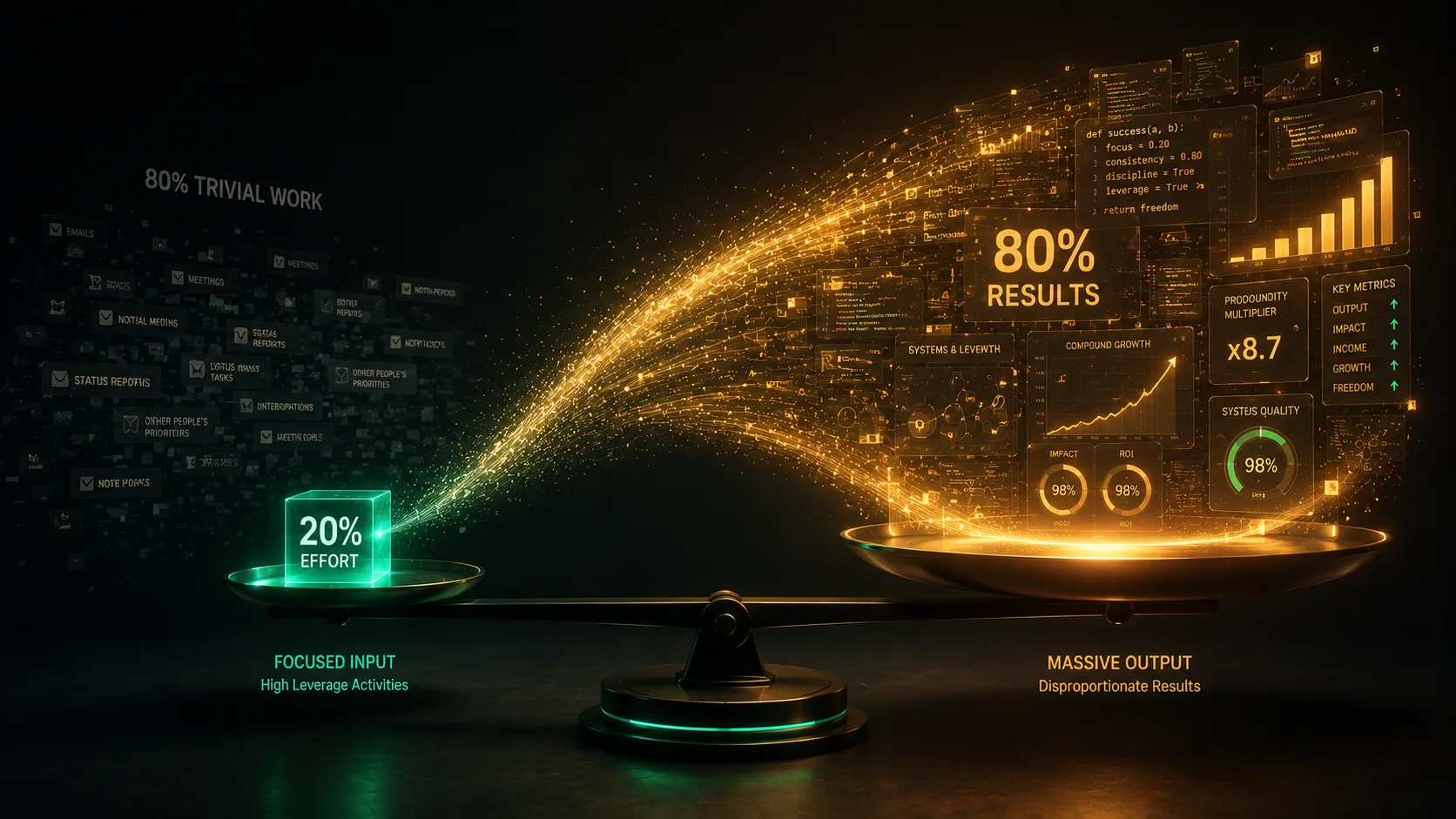
Most of your effort is producing almost none of your results — the 80/20 principle is the analytical tool that shows you exactly where.