
How to Say No to Scope Creep as a Freelancer
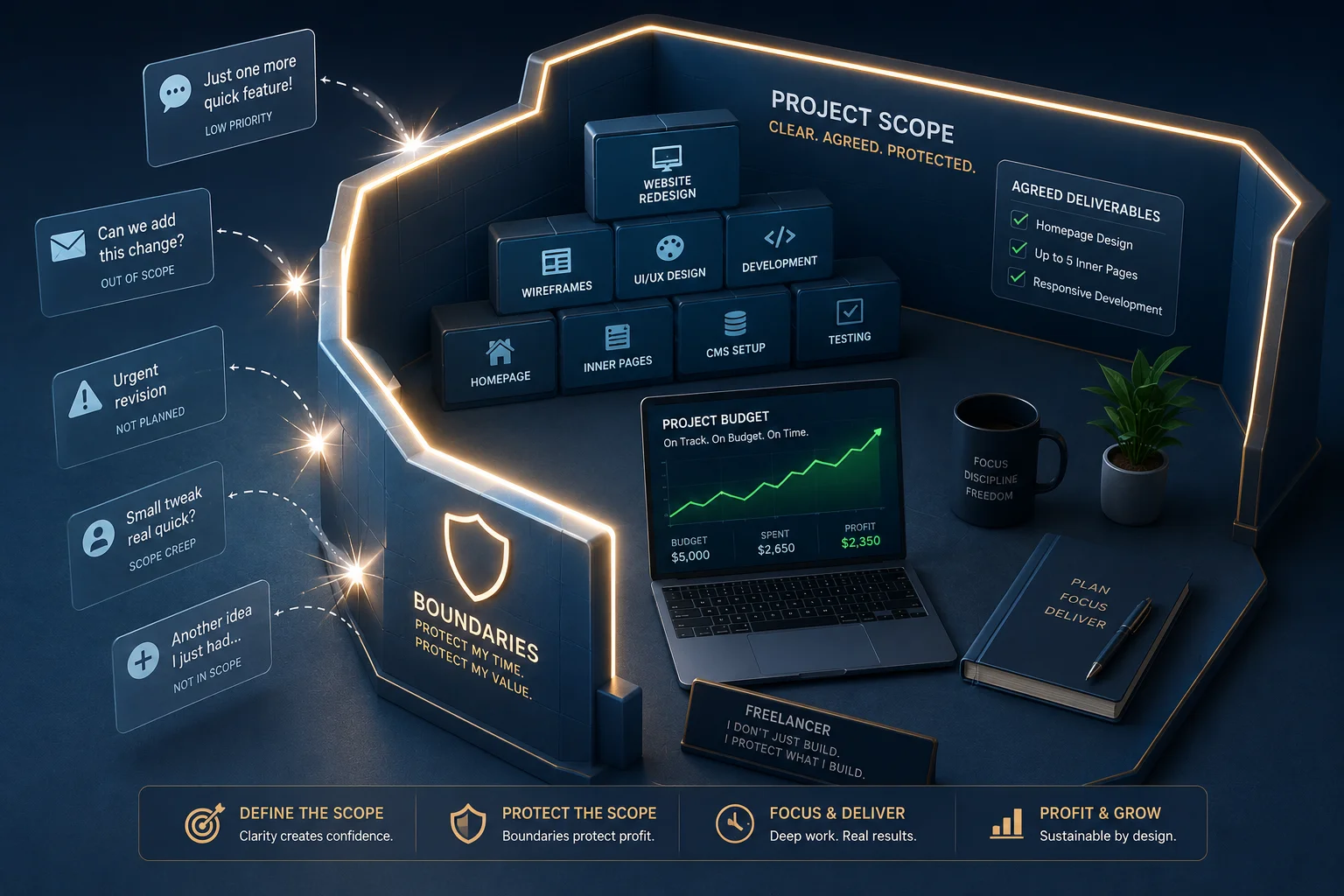
It's 11:47pm. You've just sent the final invoice for a two-week landing page project, feeling good about wrapping it on time. Then the message comes in: "Hey, this looks great! Quick thing, can we also add a blog section, a member login, and maybe just tweak the color scheme to match our new branding? Shouldn't take long, right?" Four weeks later you're still on the project, the original budget is long gone, and you're building a content management system you never quoted for, because saying yes to "quick" felt easier than the conversation about money.
Scope creep doesn't usually arrive as one obvious betrayal. It arrives as a dozen small, reasonable-sounding requests that each individually feel too petty to argue about. The cost is real, though. A 2025 survey of freelance developers and designers found the average mid-sized project absorbs 15 to 30% in unpaid scope expansion, which on a $3,000 project is $450 to $900 of free labor, plus the calendar weeks that delay your next paying client.
This guide gives you the actual mechanics: how to write a contract that closes the loopholes clients use, word-for-word scripts for the moment a request lands in your inbox, and a change order process that turns "can you just" into a paid line item without burning the relationship.
Defining Scope Creep in Freelance and Remote Tech Gigs
Before you can stop scope creep, you need a clean definition you can actually apply mid-conversation, not just recognize after the fact.
The Difference Between Good Customer Service and Unpaid Labor
Good customer service is fixing a bug you introduced, clarifying something you genuinely misunderstood from the brief, or making a five-minute adjustment that costs you nothing meaningful. Unpaid labor is anything that adds new functionality, new deliverables, or meaningfully more hours than the original scope accounted for, dressed up as a small ask.
The test that actually works: would a stranger reading your original proposal agree this was already included? If the answer is genuinely yes, it's service. If you have to stretch the wording to justify it, it's creep, and you should treat it as such regardless of how the client framed the request.
Micro-Creep: How Small Quick Favors Kill Project Profitability
A single "can you just" request rarely sinks a project. Ten of them across a six-week engagement absolutely do, because each one feels too small to charge for in isolation, and freelancers consistently underestimate the cumulative hours until they total their time at the end and the math doesn't work.
Track every out-of-scope request as it happens, even the ones you decide to absorb for free. A simple spreadsheet row with the date, the request, and an estimated time cost turns an invisible pattern into a number you can point to, either to justify a rate increase next time or to flag to the client that the project has expanded beyond what was quoted. The same discipline applies if part of your freelance income comes from content work; freelancers picking profitable TikTok niches run into the same scope drift when a brand asks for "just one more cut" of a video they never paid for.
Common Triggers: Vague Briefs, Shifted Deadlines, and Extra Revisions
Scope creep clusters around three predictable triggers. A vague brief leaves room for the client to discover new requirements mid-project that genuinely weren't on either party's radar at signing. A shifted deadline, usually the client's own internal delay, creates pressure to "use the extra time" by adding features instead of just waiting. And unlimited revisions, often promised in a moment of eagerness to win the client, get treated as an open invitation to keep iterating indefinitely rather than converging toward a final deliverable.
All three are preventable at the proposal stage, which is exactly where the next section starts.
Setting Up Bulletproof Contract Boundaries to Block Creep
Most scope creep isn't a character flaw in your clients. It's a gap in your contract that an ambiguous brief or an unlimited-revisions clause left wide open.
Writing a Crystal-Clear Statement of Work
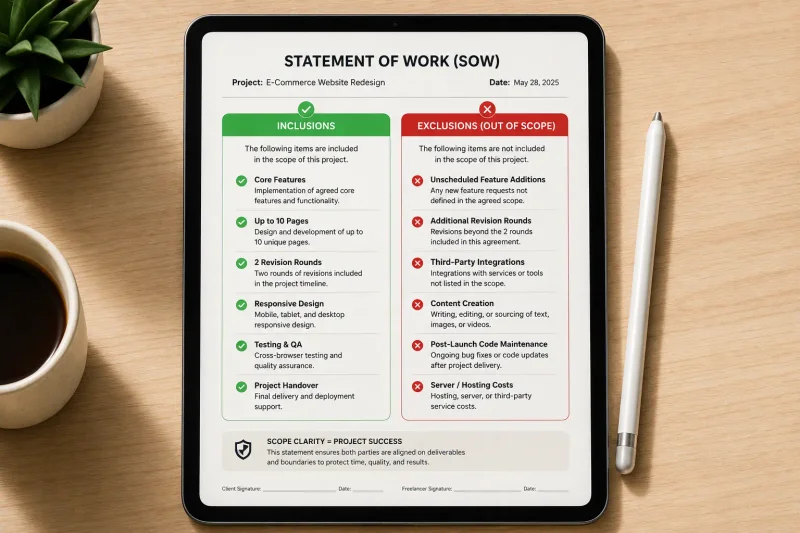
Your Statement of Work (SOW) needs specific, countable deliverables, not adjectives. "A modern, responsive website" invites argument over what "modern" means six weeks in. "A 5-page responsive website (Home, About, Services, Portfolio, Contact) built in [platform], tested on Chrome, Safari, and Firefox" doesn't.
Use this structure in every proposal going forward:
Deliverables: [Exact page or feature count, named individually] Timeline: [Start date, milestone dates, final delivery date] Revision rounds included: [Specific number, e.g. "2 rounds of revisions on the full deliverable"] Out of scope: [Explicitly named exclusions, covered next]
Defining Explicit Inclusion and Exclusion Lists in Your Proposals
An inclusion list alone leaves the door open for "well, you didn't say it wasn't included." Pair every SOW with an explicit exclusion list naming the specific things clients commonly assume are bundled in but aren't.
Sample clause to paste directly into your proposal template:
"This project includes the deliverables listed above. The following are explicitly not included and will be quoted separately if requested: custom backend development, third-party API integrations beyond what's specified, content writing or copywriting, stock photography or image licensing, ongoing maintenance after the 14-day post-launch support window, and any feature not named in the Deliverables section above."
Adjust the named exclusions to your specific service, but keep the structure: name the project's most common scope-creep triggers explicitly, in writing, before the project starts.
Establishing a Pre-Approved Hourly Rate for Extra Feature Requests
Quote a specific hourly rate for out-of-scope work inside the contract itself, so the rate isn't a negotiation you have to start cold when a request lands. Clients almost always accept a rate they already agreed to in writing over one you're proposing reactively mid-project, which reads as you making something up on the spot even when you're not.
Sample clause:
"Any work requested outside the Deliverables listed in this agreement will be billed at $[your hourly rate]/hour, with a minimum increment of [30 minutes/1 hour], and will not begin until the client confirms acceptance of the estimated hours via written approval (email is sufficient)."
How to Say No to Scope Creep With Exact Email Scripts
A solid contract sets the rules. These scripts are what you actually send when a client tests them.
Script 1: The "Happy to Help, But It Costs Extra" Response
Use this for any new feature or deliverable request that falls outside your SOW.
Subject: Re: Adding a blog section
Hi [Name],
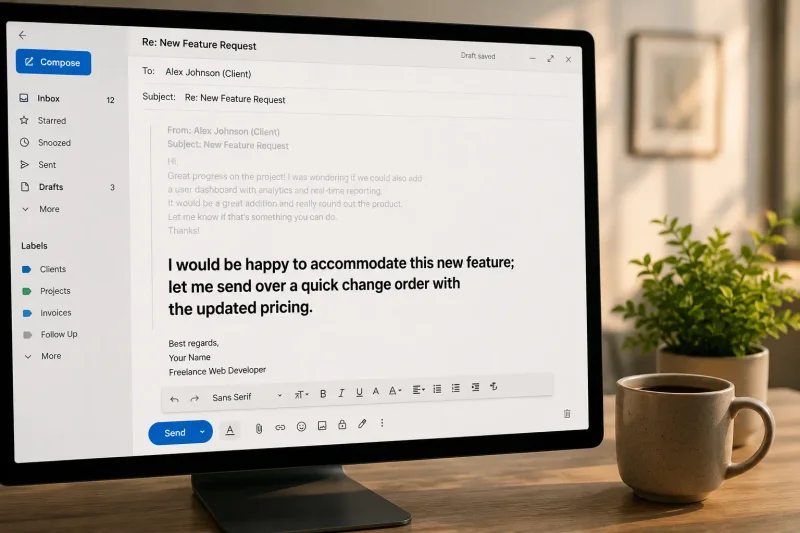
Glad you're happy with the landing page! A blog section is a great addition, and I'd be happy to build it.
Quick note: this wasn't part of the original scope we agreed on, so it'll be a separate quote. Based on what you're describing, I'd estimate around [X] hours at my standard rate of $[rate]/hour, totaling approximately $[total]. I can start on it as soon as you confirm, and it won't affect the timeline or quality of what we've already delivered.
Let me know if you'd like to move forward, and I'll send a quick addendum to sign off on before I begin.
Best, [Your name]
Script 2: The "Delayed Phase 2" Strategy for Post-Launch Additions
Use this when a request is reasonable but threatens to delay the current deliverable's launch date.
Subject: Re: A few more changes before launch
Hi [Name],
These are good ideas, and I don't want to lose them. Adding them now would push our launch date back by about [X] days though, since they fall outside what we scoped for this round.
What I'd suggest: we launch on schedule with what's currently built, and I bundle these into a Phase 2 right after, so you're live and generating value sooner instead of waiting on the full list. I can send a Phase 2 proposal this week if that works for you.
Happy to talk through it on a quick call if that's easier.
Best, [Your name]
Script 3: The "Trading Features" Approach to Protect the Original Budget
Use this when the client pushes back on paying extra but the new request genuinely can't fit alongside everything already scoped within the original timeline.
Subject: Re: Swapping the request
Hi [Name],
I want to make this work without going over budget on your end. Since [new request] wasn't part of the original scope, adding it as-is would mean either extra cost or extra time, neither of which sounds ideal for you right now.
One option: we swap it in for [existing lower-priority deliverable from the original SOW] so the total hours stay the same. That way you get [new request] without any additional cost, and we just deprioritize [the swapped item] for a future round.
Let me know if that trade works, or if you'd rather keep the original scope and add this as a separate quote instead.
Best, [Your name]
Implementing a Standard Change Order Process
Scripts handle the conversation. A change order process handles the paperwork so the conversation doesn't have to happen from scratch every time.
What Is a Change Order and Why Do You Need One
A change order is a short, signed document that formally adds a new deliverable, timeline change, or budget adjustment to an existing contract, without rewriting the whole agreement. It exists specifically to make scope changes official rather than something agreed to casually over chat and forgotten or disputed later.
Without one, every scope change lives in scattered Slack messages and email threads, which is exactly where disputes happen, since memory of who agreed to what gets fuzzy within a couple of weeks.
Step-by-Step Workflow for Documenting New Client Requests
When a new request comes in: first, acknowledge it within 24 hours using one of the scripts above, so the client knows you've seen it and aren't ignoring them. Second, estimate the hours and cost honestly, padding slightly for the inevitable back-and-forth that new features generate. Third, send a one-page change order summarizing the request, the estimated hours, the cost, and any timeline impact. Fourth, do not start the work until you get written confirmation back, even a one-line "approved, go ahead" email counts.
This four-step sequence takes maybe 15 minutes per request and prevents the much longer dispute that happens when a client is surprised by an invoice for work they don't remember explicitly approving.
Getting Written Sign-Offs on Budget Adjustments Before Starting Work
Never start out-of-scope work on a verbal "yeah sounds good" from a call. Memory is unreliable and clients genuinely forget the specifics of what they agreed to once a few weeks pass, not out of bad faith but because they're juggling far more than just your project.
Sample sign-off you can paste at the end of any change order email:
"To confirm: please reply 'approved' to this email to authorize the additional [X] hours at $[rate]/hour, totaling $[total]. Work will begin once I receive your confirmation."
That single sentence, used consistently, eliminates almost every scope dispute that would otherwise end in an awkward invoice conversation.
Managing Difficult Clients Who Push Project Boundaries
Some clients respect the process the moment you introduce it. Others test it repeatedly, and that pattern is worth spotting early.
Spotting Red-Flag Clients During the Initial Discovery Call
Ask directly during discovery: "Have you worked with a freelancer or agency before? How did that go?" A client who describes a previous freelancer as "difficult" for enforcing boundaries you'd also enforce is telling you something useful about how they'll treat your boundaries too.
Watch for vague answers to "what does success look like for this project." Clients who can't define success clearly at the start are statistically more likely to keep redefining it throughout the project, since there was never a fixed target to begin with.
Setting Communication Boundaries: No Late-Night Messages
State your communication hours explicitly in your kickoff email, not as an apology but as a fact: "I'm typically responsive between [hours] on weekdays, and I'll respond to anything outside that window the next business day." Clients calibrate to whatever boundary you state clearly and consistently; the ones who push past a clearly stated boundary are showing you exactly the kind of relationship you're in for.
Don't respond to 11pm messages immediately even if you happen to be awake. Responding trains the client that 11pm is a viable time to reach you, regardless of what your kickoff email said.
When to Fire a Client Over Chronic Scope Creep
Fire a client when scope creep becomes a pattern rather than an occasional reasonable ask, specifically when they've pushed back on two or more change orders in a row, treating your documented process itself as the thing to argue about rather than the request. At that point the relationship costs you more in stress and unpaid hours than the invoice is worth, even if the invoice looks fine on paper.
A short, professional exit script: "I don't think I'm the right fit to continue this project given where the scope has landed. I'll complete [current committed deliverable] and provide your files in a clean handoff by [date]." No need to itemize every grievance. Calm and final beats a long explanation every time. The same applies if you're firing a brand client over content scope creep, the same way a TikTok SEO guide would tell you chasing every algorithm tweak instead of a clear strategy burns you out for no real return.
- How do you politely tell a client a request is out of scope?
- Acknowledge the request positively first, then state clearly that it falls outside the original agreement and quote a specific cost or timeline impact. The "Happy to Help, But It Costs Extra" script above does exactly this in three sentences: confirm you're glad to help, name the cost, and offer a path to start once approved.
- Can I charge a client for extra work if we didn't sign a contract?
- Yes, but it's harder to enforce without a written agreement establishing your rate in advance. Send a written estimate before starting any new work and get explicit confirmation back, even over email or chat, since that exchange itself becomes your de facto agreement on rate and scope even without a formal signed contract.
- What is the main cause of scope creep in software development projects?
- Vague initial requirements are the single biggest cause, since an unclear brief leaves room for either party to discover new requirements mid-project that genuinely weren't anticipated at signing. Unlimited revision clauses and shifting client deadlines are the next two most common triggers, both of which a specific, countable Statement of Work largely prevents.
- How many revisions should a freelancer include for free?
- Two rounds is the standard most freelancers settle on: enough to address genuine misalignment with the brief without inviting indefinite iteration. State the exact number in your contract rather than leaving "revisions" undefined, and treat any round past that number as a billable change order.
- Is it ever okay to accept scope creep without charging extra?
- Occasionally, for genuinely small five-minute fixes or when you're intentionally investing in a long-term client relationship you expect to pay off later. The key is making that an intentional, occasional choice you track, not a default response to every request, since untracked free work is exactly how profitable projects quietly become unprofitable ones.
Conclusion — Protecting Your Freelance Profit Margins and Peace of Mind
Scope creep isn't a client problem. It's a documentation and communication gap that clients walk through because most freelancers never close it. A specific Statement of Work, a pre-approved hourly rate for extras, and three scripts you can paste and send in under a minute close that gap permanently, and the relationship usually gets better once boundaries are clear, not worse.
Before your next client call, write your out-of-scope hourly rate down and put it in your contract template now, not after the next "quick favor" request lands. Everything else in this guide is easier to execute once that one number exists in writing before you need it.
Related Articles
Explore the Growth & Learning hub →
Deep Work vs Shallow Work: How to Focus in a Distracted World
Most of your work hours are fake — here's how to reclaim the ones that actually produce output.

The 80/20 Principle: Work Less, Achieve More
Most of your effort is producing almost none of your results — the 80/20 principle is the analytical tool that shows you exactly where.

Build a Personal Brand as a Freelancer in 2026
The freelancer charging 5x more than you isn't more skilled, they're just harder to ignore.