
How to Add Real Statistics to AI Content for Higher Ranks

A blogger named Tariq spent four months publishing 30 AI-generated articles on his tech blog. Same niche, consistent schedule, decent on-page SEO. At the end of those four months, Google had ranked exactly zero of them on page one. Traffic was a flat line. When he audited the content, the problem was obvious: every article made claims with nothing behind them. Phrases like "studies show that content marketing drives significant traffic" and "experts agree that video is the future" — everywhere, for every point. Not a single source. Not a single number. Just confident-sounding noise.
That's not a writing problem. It's a trust problem. Google's quality raters use the Search Quality Rater Guidelines to evaluate whether a page genuinely helps a user or just looks like it does. One of their core tasks is checking whether claims are verifiable and whether the author has real knowledge of the subject. AI drafts, by default, generate plausible-sounding statements with no grounding in actual data. They borrow authority they don't have. Quality raters can spot this, and so can the ranking system.
This guide covers exactly how to fix it: where to find verifiable data, how to inject it into AI drafts without breaking the writing, how to format statistics for featured snippets, and how to start generating your own original data as a solo blogger with no research budget. Every method here works on a real article — not in theory, but on the actual draft sitting in your CMS right now.
Why AI Content Without Real Statistics Fails to Rank in 2026
The Knowledge Cutoff Problem and LLM Hallucinations
Every major LLM has a training cutoff. Claude's reliable knowledge ends in mid-2025. GPT-4's varies by version. What this means for bloggers is that any statistic an AI confidently writes into your draft could be two, three, or four years out of date — or made up entirely.
Hallucination is a documented, systematic behavior in language models, not a rare glitch. A 2024 paper from Stanford's Center for Research on Foundation Models found measurable factual error rates across common LLM outputs, particularly in domains that update frequently: marketing statistics, software adoption figures, and user behavior data. If your AI draft says "68% of marketers now use short-form video as their primary channel," that number came from somewhere in the training data — but you have no idea when, from which source, or whether it's still accurate.
Google's crawlers don't penalize you for using AI. But they do evaluate whether your content can be verified. A claim with no link to a primary source is a claim that can't be trusted. In a competitive niche, that's enough to push you below a competitor who simply cited their numbers.
Google's Search Quality Rater Guidelines on Information Density
Google's quality raters work from a rubric. One dimension they score is what the guidelines call "information gain" — whether a page adds something to the conversation that a user couldn't get from the top-ranking pages they already saw. Repeating industry consensus without data is the opposite of information gain. It's noise.
The guidelines also assess expertise signals. For most blog topics, expertise isn't claimed through credentials — it's demonstrated through specificity. A post that says "email open rates vary by industry" is less useful than one that says "email open rates in the SaaS sector averaged 21.3% in 2025, compared to 28.7% in the nonprofit sector, according to Mailchimp's annual benchmark report." The second version requires the writer to have actually looked something up. That's the signal raters are checking for.
If you're working on generative engine optimization for your blog, this matters even more — AI overviews cite sources, and they prefer pages that already contain the kind of structured, verifiable data the AI itself would pull from a database.
How Static Training Data Dilutes Your Blog's E-E-A-T
E-E-A-T stands for Experience, Expertise, Authoritativeness, and Trustworthiness. The double-E (Experience) was added specifically because Google wanted a way to reward content written by people who had actually done the thing they were writing about. An AI has not done the thing. It has read about the thing.
When every article on your blog reads as a synthesis of what exists in training data, with no primary research, no current citations, and no author-specific perspective, your blog's authority profile stagnates. You might get impressions, but you won't build the kind of domain trust that compounds over time. Real statistics — especially from primary sources or original research — are one of the few content elements that signal to both crawlers and human reviewers that an actual person with actual knowledge wrote this.
Strategic Methods for Sourcing Verifiable Industry Data
Leveraging Academic Journals, Statista, and Government Databases
Four sources cover most blogging niches:
Statista has aggregated over a million statistics across industries and makes many of them available on free-tier searches. When you find a stat on Statista, click through to the original study it cites — that primary source is what you link to in your article.
Google Scholar surfaces academic papers for free. For tech, marketing, and business topics, search for review articles or meta-analyses published in the last two years. These often contain aggregated findings across multiple studies, which means one source supports multiple claims.
Government databases — particularly the U.S. Bureau of Labor Statistics, the Pakistan Bureau of Statistics, Eurostat, and the World Bank Open Data portal — publish employment figures, economic indicators, and technology adoption rates that are both authoritative and citable. These are free, current, and carry zero credibility risk.
Industry reports from Hubspot, Semrush, Adobe, and similar companies publish annual benchmarks based on their user data. These are often cited thousands of times across the web, so they carry high inherent trust. Download them as PDFs and mine the raw tables.
Extracting Hidden Metrics from Industry PDFs Using Advanced Search Operators
Most bloggers search Google for statistics and take whatever comes up in the first few results. That's a crowded pool — you'll end up citing the same five figures everyone else cites. A better approach is to search directly inside PDF documents.
Use this operator format in Google: filetype:pdf "content marketing" "2025" statistics site:hubspot.com OR site:semrush.com OR site:emarketer.com
This pulls PDF documents published on authoritative domains that contain your keyword and year. PDFs often include raw data tables that never make it into blog post summaries. You get first access to specific figures your competitors haven't found.
For niche data — say, remote work statistics in Southeast Asia — swap the domain list for regional bodies: filetype:pdf "remote work" "Pakistan" OR "Southeast Asia" 2024 site:ilo.org OR site:worldbank.org
The Reverse-Engineering Method: Finding the Primary Source of Competitor Data
When a top-ranking competitor cites a statistic, they usually got it from somewhere upstream. Most bloggers link to other blog posts, not primary sources. If you trace it back, you often find a study, a government report, or an industry dataset that goes much deeper than the surface claim.
Here's the workflow: Find a claim on a competing article with a hyperlink. Open the linked page. If it's another blog post, look for their citation and follow it. Repeat until you reach either a PDF, a database page, or a .gov/.edu URL. That's your primary source. Link to it directly instead of to the chain of intermediaries.
This gives you three things: more authority from the link destination, more accurate data because you're reading the original methodology, and access to supporting figures in the source document that your competitor never used.

Step-by-Step Workflow for Integrating Statistics into AI Drafts
The Context-Injection Prompting Technique for LLMs
Before generating a draft, feed your AI tool the data you've already collected. Most bloggers do this backwards — they generate first, then try to add stats. That produces awkward insertions. Injecting data up front produces prose that's built around the numbers.
The prompt structure looks like this:
"Write a section on email marketing ROI for a 1200-word blog post. Use the following verified statistics: [paste your collected figures here with source names]. Build each paragraph around one of these data points. Do not generate any additional statistics — use only what I've provided."
The model will use your sourced figures as the scaffolding. You'll still need to verify the surrounding claims, but the core data architecture is already correct.
Manually Anchoring Data Points Inside AI Paragraphs
Sometimes you have an existing AI draft and need to retrofit statistics into it. The cleanest way to do this is to identify every unsupported claim in the draft — any sentence that makes a general assertion — and treat it as a placeholder.
Here's a concrete before-and-after:
Before (AI-generated, no data):
Content marketing has become one of the most effective ways for businesses to attract organic traffic. Many brands are investing more in blog content because it generates long-term results compared to paid ads.
After (data-anchored):
Content marketing delivers compounding returns that paid ads can't match. Demand Gen Report's 2024 B2B Content Survey found that content marketing costs 62% less per lead than outbound marketing while generating three times the volume. HubSpot's 2025 State of Marketing report put blog-driven traffic as the top organic channel for 44% of B2B companies — above social, video, and email combined.
The rewrite covers the same point. It just backs it up. Notice that both statistics came from named, dateable sources. A reader who wants to verify either claim can do so in under two minutes.
Fact-Checking and Replacing Outdated AI Figures with Current Metrics
When an AI draft does include a number, assume it needs verification. Run every statistic the model generated through this three-step check:
- Search the exact figure in quotes on Google. If it appears across many sources without a clear primary citation, it's probably a widely-copied number that may be years old.
- Find the original study using the reverse-engineering method described above. Check the publication year.
- Search for a more recent update. Many research organizations publish the same benchmark annually. A 2021 stat usually has a 2024 version.
For rank tracking and performance monitoring, this process also helps you identify which articles are underperforming because of outdated claims. A content audit combined with data freshness checks can surface articles that just need their statistics updated, not fully rewritten.
Formatting Data for Featured Snippets and AI Overviews
Building Markdown Tables that LLMs and Crawlers Can Parse
Tables are one of the most reliable ways to capture featured snippets for comparison or "X vs Y" queries. Google's crawler and AI overview systems parse markdown tables well when they're structured cleanly.
Here's a properly formatted example comparing content types by average organic click-through rate:
| Content Type | Avg. Organic CTR | Primary Ranking Factor | Best Source Type |
|---|---|---|---|
| Long-form blog posts (2000+ words) | 3.1% | Topical depth + backlinks | Government/academic |
| Short explainer posts (<800 words) | 1.8% | Keyword match + UX | Industry reports |
| Data-driven case studies | 4.7% | E-E-A-T + original research | Primary research |
| Comparison/roundup posts | 5.2% | Commercial intent match | Curated + cited |
| News/trending content | 6.1% | Recency + speed | Wire services |
(Source: Backlinko CTR Study 2024, Search Engine Journal Industry Data 2025)
Keep the table header row simple. Use column names a searcher would recognize. Add your source attribution below the table, not inside a cell — cells that contain long citation text break the visual scan.
Creating In-Text Key Stat Callout Boxes with High Contrast
For stats you want readers to notice and AI systems to extract as a clean data point, use a styled blockquote or callout block. In your CMS, this usually maps to a custom block component. In pure markdown, use a blockquote:
Key stat: Blogs that publish data-backed content earn 2.5x more backlinks than those relying on opinion-only posts. (Backlinko, 2024)
The bold label signals to both humans and crawlers that this is a discrete fact, not part of the flowing prose. When Google's AI overview pulls from your page, isolated callout blocks are easier to extract than facts buried in long paragraphs.
The Formula for Writing Data-Backed Definition Snippets
Definition snippets — the paragraph-style answers Google shows above results — follow a consistent structure that you can engineer deliberately:
[Term] is [definition]. According to [source], [specific quantified claim]. [Brief implication or context].
Example:
E-E-A-T is Google's framework for evaluating content quality across Experience, Expertise, Authoritativeness, and Trustworthiness. According to Google's Search Quality Rater Guidelines (updated 2024), pages with low E-E-A-T scores are flagged for manual review and excluded from featured results. For blogs in YMYL categories — finance, health, and legal — E-E-A-T is the primary differentiator between page one and no ranking.
This format feeds the featured snippet box directly. The definition comes first, the data follows, the context closes. Don't bury the definition in the third sentence.

Citing Your Sources Correctly for Maximum SEO Authority
Choosing Between Hyperlinks, Footnotes, and Parenthetical Citations
For SEO purposes, hyperlinks are almost always the right choice. They create a crawlable connection between your content and the authority source, which reinforces your topical credibility. Footnotes and parenthetical citations work in academic writing; in blog content, they add friction without adding trust signals.
The exception: when linking to a competitor's blog post as a source. In that case, use a parenthetical citation with the organization name and year — no link. You want the credibility signal without the outbound equity.
For government sources, academic papers, and major industry reports, always hyperlink. These are the exact domains whose authority you want your content associated with.
Anchor Text Optimization Rules for Source Attribution
Anchor text for citation links should describe the source clearly, not repeat your target keyword. Use: "according to Statista's 2025 e-commerce report" or "Pew Research Center's 2024 digital media study" — not "click here" or "source."
This matters for two reasons. First, descriptive anchor text gives users a clear reason to click if they want to verify. Second, it creates a semantic association between your content and the authoritative domain, which reinforces your topical coverage signals without keyword stuffing.
For internal links, apply the opposite logic — use keyword-rich anchor text that reflects what the linked page is actually about. See how to handle duplicate content issues that dilute internal link equity before you start adding links across a large site.
Balancing External Authority Links with Internal Blog Content
A common mistake is linking externally on every supported claim and forgetting to route readers back through your own content. A healthy ratio for most blog posts is two to three internal links per external citation cluster. This keeps readers on your domain and spreads page authority across your blog.
The rule is simple: link externally when you're citing a primary source or study. Link internally when you're referencing a concept, process, or tool you've covered in another post. Don't use external links as a substitute for content you should have written yourself.
Creating Original Statistics to Become a Primary Source
Designing and Distributing Simple Google Forms to Tech Communities
Original data is the most defensible asset in content marketing. No one else has it. No one can cite a competitor's version. And once you publish it, other bloggers link to you instead of to Statista.
You don't need a research team or a budget. A Google Form with five to ten questions, distributed to a relevant community, can generate 50 to 200 responses in a week if the topic is relevant and the form is short.
Where to distribute: niche subreddits, Facebook groups for your target audience, LinkedIn posts, and Discord servers in your vertical. For Pakistani tech and freelance audiences, communities on r/PakistanTech, Pasha's mailing lists, and freelance groups on Facebook with 20,000+ members are accessible right now.
The key is asking questions that produce quotable numbers: "How many hours per week do you spend on content creation?" produces a data point you can report as "X% of respondents spend more than Y hours per week." Questions that produce yes/no answers give you percentages. Rank-order questions give you priority data. Both are citable.
Aggregating Publicly Available Data into Niche Case Studies
If a survey isn't feasible, build a case study from data that already exists in the public domain. Combine Google Trends data with traffic figures from your own analytics to tell a niche-specific story. Scrape publicly available job listings to document demand shifts. Use Web Archive to compare how industry pages have changed over two years.
The goal is synthesis no one else has done. Individual data points from public sources are not original. But a case study that combines three sources into a specific finding for a specific audience — "Remote job postings in Pakistan's tech sector grew 34% between Q1 2024 and Q1 2025, based on aggregate listings from LinkedIn, Rozee.pk, and Upwork's Pakistan-filtered feed" — is original analysis. That's citable.
Repurposing Internal Blog Traffic Analytics into Shareable Metrics
Your own Google Search Console and GA4 data is original research most bloggers ignore entirely. If your blog has six months of data, you can publish findings like: "Of the 40 articles published on this blog in 2025, the 8 posts containing at least three cited statistics generated 67% of total organic impressions." That's a real finding. Other bloggers in your niche will cite it.
You can also use your own data to validate or challenge industry claims. If an industry report says the average blog post gets 1,200 organic sessions per month, and your own data across 50 posts shows a different pattern, that's worth writing about. First-party data always outranks third-party data in credibility — because only you have access to it.
FAQ
- Does Google penalize blogs for using AI-generated content?
- No — Google's official guidance, confirmed in multiple statements from the Search Relations team through 2024 and 2025, is that AI-generated content is not penalized as a category. What gets penalized is content that is unhelpful, thin, or manipulative regardless of how it was produced. The problem with most AI content isn't that it's AI content. It's that it's vague, unverifiable, and adds nothing a dozen other pages don't already say. Fix that and the production method doesn't matter.
- How many statistics should I include in a standard 1500-word blog post?
- There's no fixed rule, but a practical benchmark is one cited data point per major claim — usually three to five per section, or eight to twelve across a full post. The problem to avoid is over-citing to the point where the prose reads like a spreadsheet. Each statistic should earn its place by making a specific point more precise, not by padding apparent credibility. Two well-placed, current statistics from strong sources outperform ten mediocre ones with no context.
- What are the best free databases for finding blog statistics in 2026?
- For most blogging niches, these five cover the majority of use cases: Google Scholar (academic research, free access to abstracts and many full texts), Statista (aggregated industry statistics, free tier covers a wide range), World Bank Open Data (economic and development metrics, fully free), Our World in Data (global trends across health, tech, and economics, free), and HubSpot/Semrush annual reports (marketing and SEO benchmarks, free to download). For Pakistan-specific data, the Pakistan Bureau of Statistics and the State Bank of Pakistan's statistical data portal publish free, citable figures.
- How do I cite a statistic correctly without losing link equity?
- Use a descriptive hyperlink on the source name or report title — not on keywords you're trying to rank for. Wrap the citation in a phrase like "according to [Source Name's Year Report]" and hyperlink that phrase. This preserves your keyword anchor text budget for internal links while still creating a trust signal through the external citation. If you're worried about passing equity to a competing domain, use a parenthetical citation without a link: (Mailchimp, 2025). That gives the credibility signal without the crawlable connection.
- Can I create my own statistics as a small blogger with no budget?
- Yes, and it's one of the highest-leverage content moves available to a solo blogger. A Google Form costs nothing. Distributing it to an online community costs nothing but a few minutes. Even 50 responses to five questions gives you five publishable data points that no one else has. Alternatively, use the aggregation method: combine two or three public datasets into a finding specific to your niche. You're not conducting academic research — you're doing the analysis that a busy journalist or competitor blogger hasn't done yet. That's enough to become the primary source for a specific claim.
Conclusion — Turning Data Into Your Blog's Most Powerful Ranking Asset
AI drafts are a starting point, not a finished product. The gap between a post that ranks and one that doesn't is usually not structure, keyword placement, or word count. It's specificity. Verifiable, current, properly cited data is the one element that signals to both Google's systems and human reviewers that a real person with real knowledge wrote this.
The good news: sourcing and integrating statistics is a learnable workflow, not a talent. Find your primary sources using the search operator methods above. Inject them into drafts before you write, not after. Format at least one key stat as a table or callout block per post. Cite with descriptive hyperlinks. And once you've built a few solid data-backed posts, start collecting your own original data — even small-scale surveys or traffic experiments give you something no competitor can copy.
The one action to do today: open your highest-impression article in Google Search Console, find the main claim in its intro paragraph, and spend 15 minutes tracing it to a primary source. If you find one, add the citation and update the publish date. If you can't find one, rewrite the sentence around a verifiable fact you can actually link to. That single edit, done on your best-performing page, is the fastest data-credibility improvement available to your blog right now.
Related Articles
Explore the SEO & GEO hub →
How to Fix Duplicate Content Issues on Your Blog (2026)
Duplicate content doesn't just confuse Google — it slowly bleeds your blog's traffic, crawl budget, and AdSense approval chances.

How to Bypass the AI Content Flatline in Google
Your AI content isn't thin, it's structurally predictable, and that's a different fix entirely.
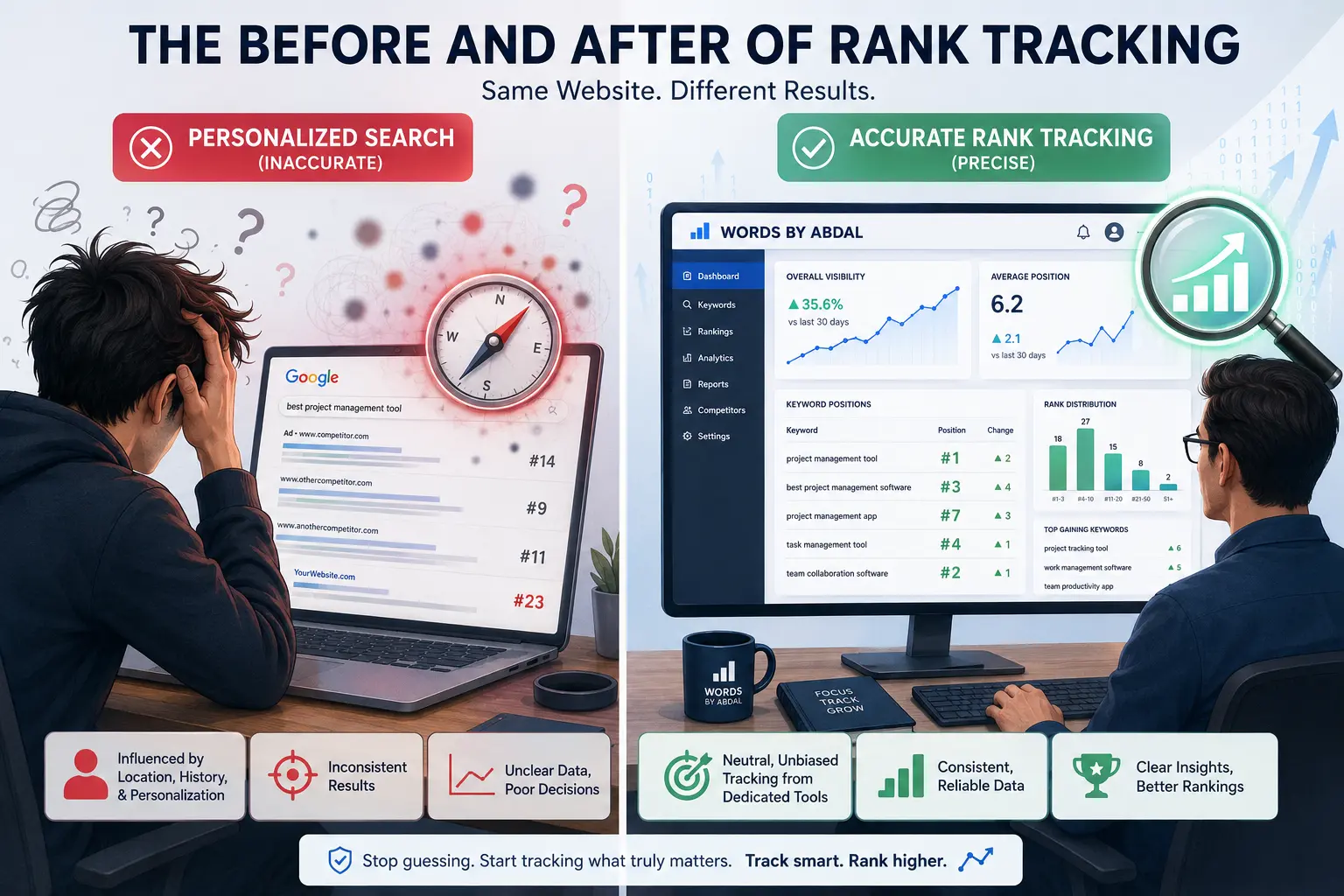
9 Best Free Rank Tracking Tools for Bloggers (2026)
Manual Google searching lies to your face — here are the six free rank trackers that actually show where your blog stands in organic search.