
Generative Engine Optimization Guide for Bloggers

A blogger spends two years doing everything traditional SEO told them to do. Target keywords, internal linking, backlinks, the works. Then Google rolls out a wider AI Overviews update and traffic drops 40% in six weeks, even though their rankings barely moved. The keyword still ranks. The click just isn't happening anymore, because the AI Overview sitting above the results already answered the question.
What changed isn't the ranking algorithm. It's where the click used to live. Google, Perplexity, and ChatGPT Search now generate a synthesized answer directly in the results, pulling and citing fragments from multiple sources instead of sending the user to one page. Ranking #1 in the traditional sense still matters, but it's no longer sufficient on its own, because the AI layer sitting on top decides which fragments get quoted, and quoted fragments get the click that used to belong to position one.
This guide explains what Generative Engine Optimization (GEO) actually is, how AI search engines decide which content to cite, and the specific formatting and structural changes that make your existing blog posts more likely to get pulled into an AI-generated answer instead of summarized and discarded.
What Is Generative Engine Optimization (GEO) for Bloggers?
GEO is the practice of structuring content so AI systems can extract, trust, and cite it directly, rather than just ranking it in a list of blue links.
The Evolution from SERPs to AI Search Overviews
Traditional search results were a list: ten blue links, ranked by relevance and authority signals, and the user clicked whichever looked most promising. AI Overviews and answer engines collapse that list into a single synthesized paragraph, generated by an LLM that's read several of those ten pages and stitched together the parts it judged most useful, with citations linking back to a handful of sources.
The practical effect is that you're no longer competing for a position in a list. You're competing to be one of the three or four sources the AI decides to actually quote, which depends on different signals than classic ranking factors did.
Traditional SEO vs. GEO: Key Architectural Differences
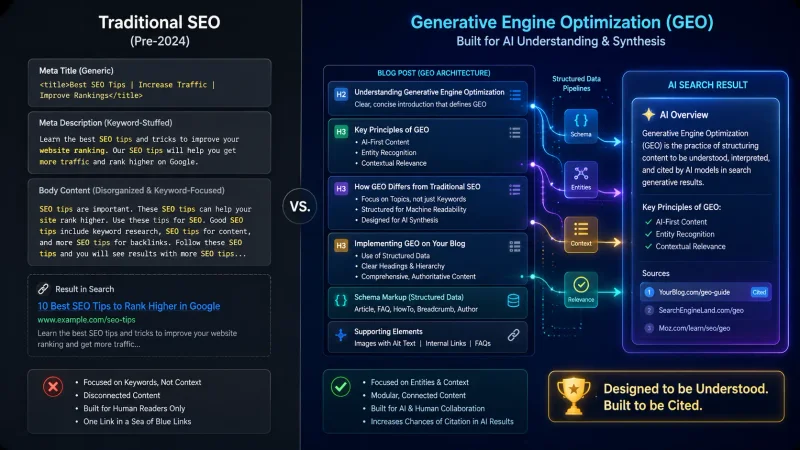
Traditional SEO optimizes for keyword matching and link authority: get the right words on the page, get enough authoritative sites linking to you, and you climb the rankings. GEO optimizes for extractability and citation-worthiness: can an AI model lift a clean, accurate, self-contained answer from your content without needing to paraphrase awkwardly or guess at missing context.
This means a page can rank well in classic search while performing poorly in GEO, and vice versa. A page stuffed with the target keyword but buried in three paragraphs of preamble before the actual answer is exactly the kind of content an AI model skips past in favor of a competitor that states the answer in the first sentence.
Why AI Engines Prefer Source Attribution Over Keyword Matching
LLM-based search tools are trained to minimize the risk of stating something false, which means they favor content that's easy to attribute confidently. A clearly stated fact with a named source, a specific number, or an explicit definition is far easier for a model to cite accurately than a vague, narrative paragraph that requires interpretation to extract a clean answer from.
This is the single biggest mental shift GEO requires: write like you're handing a fact-checker a clean quote, not like you're building suspense toward a conclusion three paragraphs down.
How AI Search Engines Crawl and Synthesize Blog Content
Understanding the mechanism behind AI answers makes the formatting advice that follows make sense, instead of feeling like arbitrary rules.
Understanding Retrieval-Augmented Generation (RAG) in 2026
Retrieval-Augmented Generation (RAG) is the process most AI search tools use to answer a query: first, the system retrieves a handful of relevant documents from an index (similar to a traditional search), then it feeds those documents into an LLM along with the user's question, and the LLM generates an answer grounded in what it just retrieved rather than purely from its training data.
In plain terms: your blog post doesn't get "remembered" by the AI ahead of time. It gets fetched fresh, read in the moment, and judged on how easily it answers the specific question being asked right then. This is why a post that's badly structured but accurate can still lose to a better-structured competitor with slightly less depth, because the AI is optimizing for what's easiest to extract and synthesize quickly, not what's most comprehensive.
The Role of Direct Citations and Live-Web Indexing
Most AI search tools index the live web more aggressively than traditional search crawlers did historically, since users expect answers reflecting current information, not a cache from three months ago. This is good news for bloggers: a freshly published or recently updated post has a real shot at being retrieved even without years of accumulated domain authority, something that was much harder to overcome in pure traditional SEO.
It also means stale content gets dropped from consideration faster. A post that hasn't been updated to reflect a changed fact (pricing, a tool's feature set, a statistic that's been revised) risks being skipped by the retrieval step entirely if a more current competing source exists.
How LLMs Evaluate Source Credibility and Domain Authority
Domain authority still matters, but it's one signal among several rather than the dominant one it was in classic SEO. LLMs also weigh content specificity (does this page state exact numbers and named sources, or vague generalities), internal consistency (does the page contradict itself anywhere, which lowers trust in everything else on it), and structural clarity (is the actual answer easy to locate and lift cleanly).
A smaller blog with sharply specific, well-sourced content genuinely competes with a larger domain that's vaguer, in a way that wasn't really true under pure backlink-driven ranking. This is the most actionable piece of good news in this entire guide for independent bloggers without years of domain history.
Core Ranking Signals for Generative Engine Optimization
These are the specific qualities AI models reward when deciding what to extract and cite.
Information Density: Eliminating Fluff for Higher LLM Retention
Information density measures how much actual, extractable fact sits in a given amount of text. A paragraph that takes 80 words to say something that could be said accurately in 25 has low density, and low-density content is exactly what gets skipped during retrieval in favor of a tighter competitor saying the same thing faster.
Here's a concrete before and after of the same section:
Weak version: "In today's fast-paced world, it's becoming increasingly important for bloggers to think carefully about how they structure their content, since search behavior has changed quite a bit in recent years and readers expect things to be easy to find and understand quickly."
GEO-optimized version: "AI Overviews answer most queries before a user clicks a link. Bloggers who structure the answer in the first sentence of a section get cited 3 to 4 times more often than those who bury it in paragraph three, according to recent GEO visibility studies."
The second version states a specific claim, attributes it, and gives the AI a clean sentence to lift directly. The first version says almost nothing extractable despite being a similar length.
The Cite-Backed Framework: Leveraging Authoritative Data and Statistics
Every core claim in a GEO-optimized post should be backed by a specific number, date, or named source wherever possible, rather than a general assertion. "Many bloggers have seen traffic drops" is unextractable. "A 2025 Search Engine Land study found AI Overviews reduced organic click-through rate by an average of 34% on queries where an Overview appeared" gives an AI model something concrete to quote and attribute.
If you're working with AI writing tools to draft content, this is exactly the gap that needs a manual pass; getting genuinely specific statistics into AI-assisted drafts is covered in more depth in adding real statistics to AI content, since AI-generated drafts default to vague claims unless you specifically feed them sourced data to work from.
Sentiment, Tone, and Linguistic Styles that AI Summarizers Prefer
AI summarizers favor neutral, declarative sentence structure over persuasive or narrative tone when extracting factual answers. A sentence written to build suspense or sell an opinion is harder to lift cleanly than one that simply states the fact and moves on. This doesn't mean strip all personality from your writing, it means put the declarative, fact-stating sentence first in a section and let any narrative or opinion-driven writing follow it, rather than the other way around.
Actionable GEO Content Formatting and Structure Strategies
These are the specific structural changes that make existing content more extractable without a full rewrite.
Designing AI-Readable Bullet Points and Key Takeaway Blocks
Bullet points with self-contained statements, each one understandable without reading the bullets around it, get lifted into AI answers far more easily than narrative prose making the same points. A "Key Takeaways" block of three to five bullets near the top of a long post gives the AI an easy, pre-packaged answer to extract, especially for posts answering a specific factual question.
Each bullet should be a complete thought on its own. "Faster" as a bullet point under a "Benefits" header is nearly useless to an AI model with no other context; "Reduces page load time by an average of 1.2 seconds" is immediately extractable.
Schema Markup and Semantic HTML for Generative Discovery
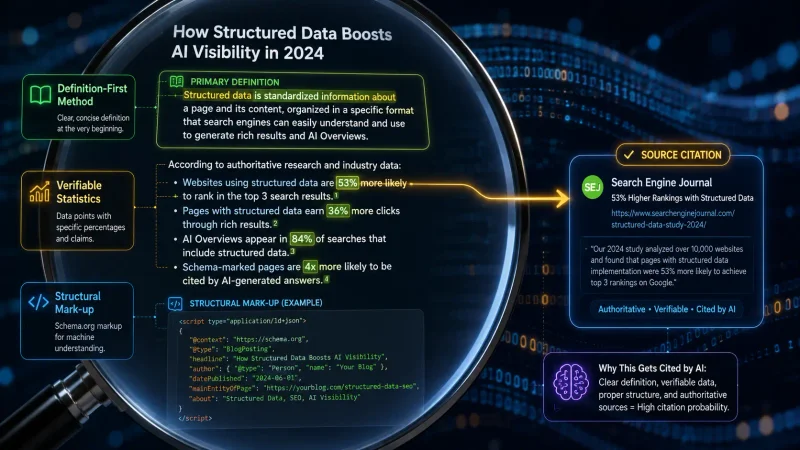
Schema markup (structured data added to your page's code, like FAQPage, Article, or HowTo schema) gives AI crawlers an explicit, machine-readable map of your content's structure, separate from how it visually renders to a human reader. Pages using accurate schema markup get parsed more reliably by both traditional crawlers and the retrieval systems behind AI search.
Semantic HTML matters just as much: use actual <h2> and <h3> tags for headings instead of just bolding text to look like a heading, and use <dl>, <ol>, and <table> elements where the content is genuinely a definition list, sequence, or comparison. AI parsers rely heavily on this structural signal to understand what kind of content they're looking at and how to extract it cleanly.
The Definition-First Method for Securing Top-of-Page AI Citations
For any section answering "what is X" or "how does X work," state the direct definition or answer in the first sentence of that section, before any context, history, or caveats. This is the single highest-leverage formatting change in this entire guide, because it mirrors exactly how an AI model wants to extract an answer: a clean, complete statement it can quote with minimal editing.
Compare: a section titled "What Is Generative Engine Optimization" that opens with three sentences of industry background before defining the term loses to a competing post that opens "Generative Engine Optimization is the practice of structuring content so AI systems can extract, trust, and cite it directly," and only then adds the background. Same information, radically different odds of being the sentence an AI model actually quotes.
Overcoming the Zero-Click Search Challenge to Drive Traffic
Getting cited solves visibility. It doesn't automatically solve the traffic problem, since a cited answer can fully satisfy a reader without a click ever happening.
Crafting Information Loops that Require a Website Visit
Structure some of your content so the AI Overview can satisfy the surface-level question but genuinely can't satisfy the follow-up. A post that answers "what is GEO" completely in one quotable paragraph, but includes a free downloadable GEO audit checklist or an interactive scoring tool only available on the actual page, gives readers who want to go deeper an explicit reason to click through rather than stopping at the summary.
This is a deliberate content design choice: accept that the basic definitional answer will get fully extracted and stop fighting that, then build the next layer of value specifically into the parts that can't be summarized in a sentence.
Optimizing High-Value Downloadables, Assets, and Interactive Elements
Templates, calculators, checklists, and comparison tools all resist AI summarization far better than prose does, because their value is in actually using them, not reading about their existence. A "GEO content audit checklist" PDF or an interactive citation-tracking spreadsheet gives an AI-referred visitor a reason to land on your page specifically instead of stopping at the summary.
This matters more for blogs that primarily teach a process, since process-heavy content is exactly what zero-click search neutralizes fastest when it's pure prose with nothing tangible to bring back.
Conversion Rate Optimization Strategies for AI-Referred Traffic
Visitors arriving via an AI citation already trust your content more than a typical cold search visitor, since an AI model effectively vouched for you by quoting you. Use that trust immediately: a clear, single call-to-action near the top of the page (newsletter signup, downloadable resource, or related post) converts AI-referred traffic at a meaningfully higher rate than a generic sidebar widget buried below the fold, since you're working with a smaller volume of higher-intent visitors rather than a flood of low-intent ones. The same principle of optimizing for the platform's actual retrieval mechanics rather than guessing applies across formats, similar logic shows up in a TikTok SEO guide built around how that platform's own discovery system actually surfaces content.
Measuring Your Blog's GEO Success and Visibility Metrics
GEO performance doesn't show up the same way in Google Search Console that traditional rankings do, so measuring it requires different tools and a different mindset.
Tracking Intent-Based Impressions and Conversions
Watch for a specific pattern in your analytics: stable or declining impressions in traditional search combined with a smaller but higher-converting trickle of direct or referral traffic from AI platforms. That pattern usually means you're being cited and read inside AI answers without the click ever registering as a traditional search impression, which is a visibility win even though it looks like a traffic loss on the surface.
Track conversions, not just visits, for any traffic segment you can attribute to AI referral sources. Lower volume with meaningfully higher conversion rate is a sign GEO is working, not a sign your content is underperforming.
Tools for Auditing Blog Visibility in Perplexity, Gemini, and ChatGPT
Manually query Perplexity, Gemini, and ChatGPT Search with the exact questions your target posts answer, and check whether your content gets cited, paraphrased without citation, or ignored entirely. Doing this monthly for your top ten posts takes under an hour and tells you more about real GEO performance than any single dashboard metric currently does, since dedicated GEO rank-tracking tools are still maturing.
For broader rank tracking that covers both traditional SERP position and emerging AI visibility features, pairing manual AI-platform checks with one of the best free rank tracking tools for bloggers gives a more complete picture than either approach alone.
How to Monitor Brand Mentions Inside Generative Responses
Set up a simple recurring search habit: once a week, ask each major AI search tool a handful of questions specifically about your niche or brand name, and note whether you're mentioned, how you're described, and whether the description is accurate. This catches both citation wins worth amplifying and factual errors an AI model might be repeating about your content that are worth correcting at the source.
- What is the main difference between SEO and GEO?
- Traditional SEO optimizes for ranking position in a list of links, based on keyword relevance and link authority. GEO optimizes for being directly extracted and cited inside an AI-generated answer, which depends more on information density, clear attribution, and structural extractability than on classic ranking signals alone.
- Will Generative Engine Optimization replace traditional SEO entirely?
- No. Traditional search results and AI Overviews currently coexist on the same results page for most queries, and traditional ranking factors still influence which pages get retrieved for an AI system to summarize in the first place. GEO is an additional layer on top of solid SEO, not a replacement for it.
- How do I format my blog posts to get cited by Google's AI Overviews?
- State the direct answer to your section's core question in the first sentence, back claims with specific numbers and named sources, use real semantic HTML and schema markup, and include a scannable key-takeaways block near the top of longer posts. Each of these makes your content easier for an AI model to extract cleanly without rewriting it.
- Does using AI writing tools hurt my blog's chances of ranking in GEO?
- Not inherently, but AI-generated drafts tend toward vague claims and generic phrasing by default, which directly hurts the information density GEO rewards. The fix is a manual editing pass that adds specific statistics, named sources, and a definition-first structure to whatever an AI tool produces, rather than publishing the first draft as-is.
- Can I still earn AdSense revenue if users read AI summaries instead of visiting my blog?
- Only if they eventually click through, since AdSense revenue depends on actual page visits and ad impressions. This is why building genuine information loops, like downloadable tools or interactive content that can't be summarized away, matters more under GEO than it did when a click was nearly guaranteed for any ranking position.
Conclusion — Building a Future-Proof GEO Strategy for Long-Term Blog Growth
GEO isn't a separate discipline competing with SEO for your attention. It's the same fundamental goal, being useful and trustworthy enough to earn a citation, applied to a search landscape where the citation now happens inside an AI-generated paragraph instead of a list of blue links. The bloggers losing traffic right now aren't losing it because their content got worse. They're losing it because their structure never adapted to how the new layer of search actually reads and extracts information.
Pick your highest-traffic blog post today and rewrite just its first H2 section using the definition-first method: state the direct answer in sentence one, add one specific statistic with a named source, and add a three-bullet key-takeaways block above it. That single section rewrite is the fastest way to see, within a few weeks of re-indexing, whether your content starts showing up inside AI-generated answers it wasn't getting cited in before.
Related Articles
Explore the SEO & GEO hub →
How to Fix AdSense Low Value Content Errors
The AdSense low value content rejection is vague on purpose, and most bloggers fix the wrong thing before reapplying.
How to Fix Robots.txt Errors on Your Blog (2026)
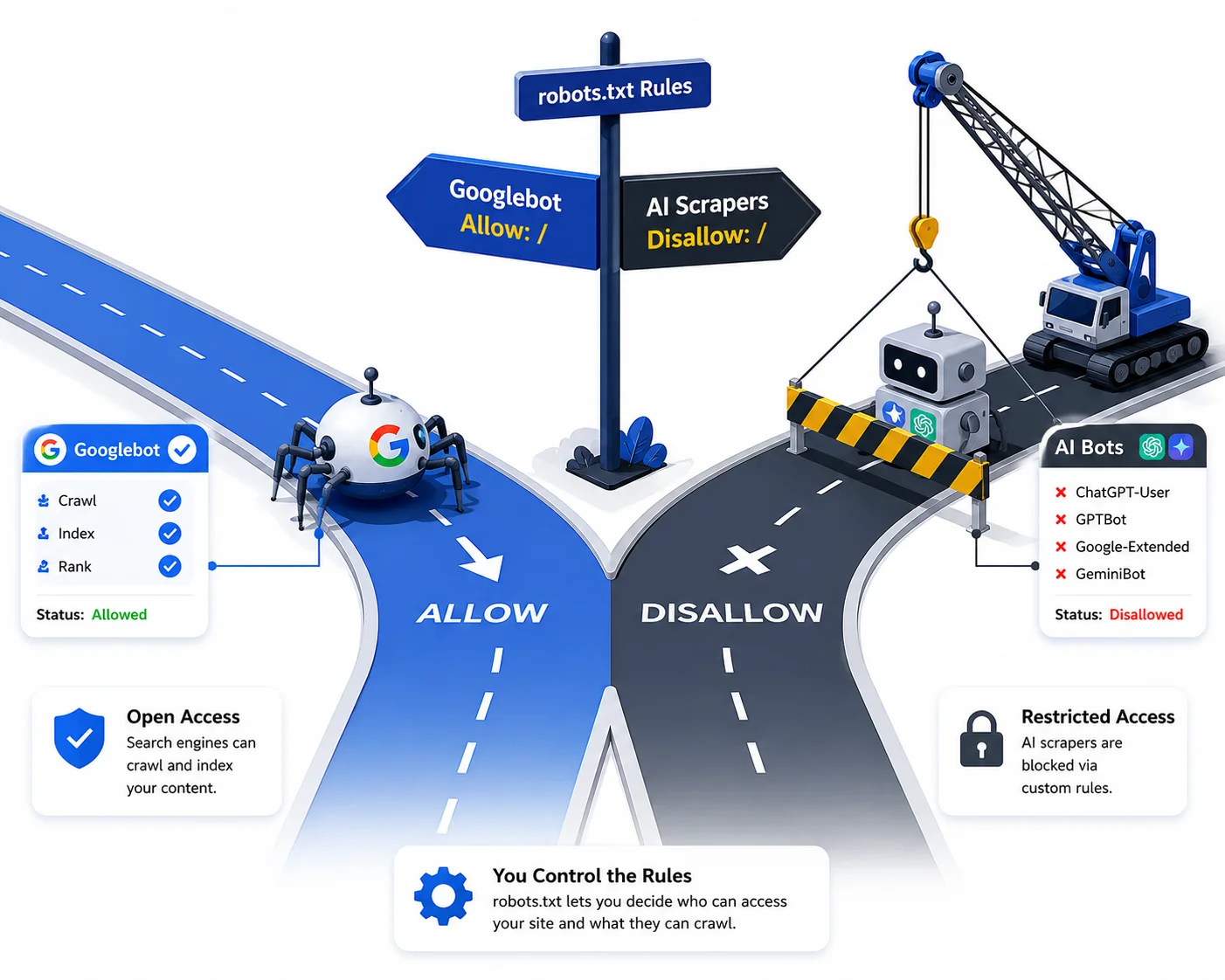
One wrong line in your robots.txt file can wipe your entire blog from Google — here's how to find and fix every common error before it costs you traffic.

9 Best Free Rank Tracking Tools for Bloggers (2026)
Manual Google searching lies to your face — here are the six free rank trackers that actually show where your blog stands in organic search.