
Build a Personal Brand as a Freelancer in 2026

Picture two freelancers. One has five years of solid work, a clean portfolio, and is currently one of 40 proposals sitting in an Upwork inbox for a $200 logo design job. The other has maybe two years of experience, a noticeably thinner skill set, and charges $1,000 for the same category of work, because clients find them directly, already convinced, already comparing them to nobody. The skill gap runs one direction. The income gap runs the other.
What changed by 2026 is that generative AI collapsed the value of "I can technically do the task." Clients can now get a passable first draft of a logo, a blog post, or a landing page from a prompt in under a minute, for free. What they can't get from a prompt is judgment: someone who understands their specific market, has a visible track record of solving that specific problem, and can be trusted to make good calls without hand-holding. That shift didn't kill freelancing. It killed the version of freelancing where being competent and invisible was enough to get paid well.
This guide covers the actual mechanics of building a freelance personal brand in 2026: picking a micro-niche narrow enough to dominate, optimizing the two or three platforms that actually send inbound client interest, producing proof-of-work content that does the selling for you, reaching out to better clients without sounding desperate, and repricing your services once your name starts carrying weight. It ends with a 30-day plan with a specific first move, not a vague call to "start today."
The 2026 Freelance Pivot: Why Traditional Portfolios Are Failing
The Decline of Traditional Upwork and Fiverr Bidding
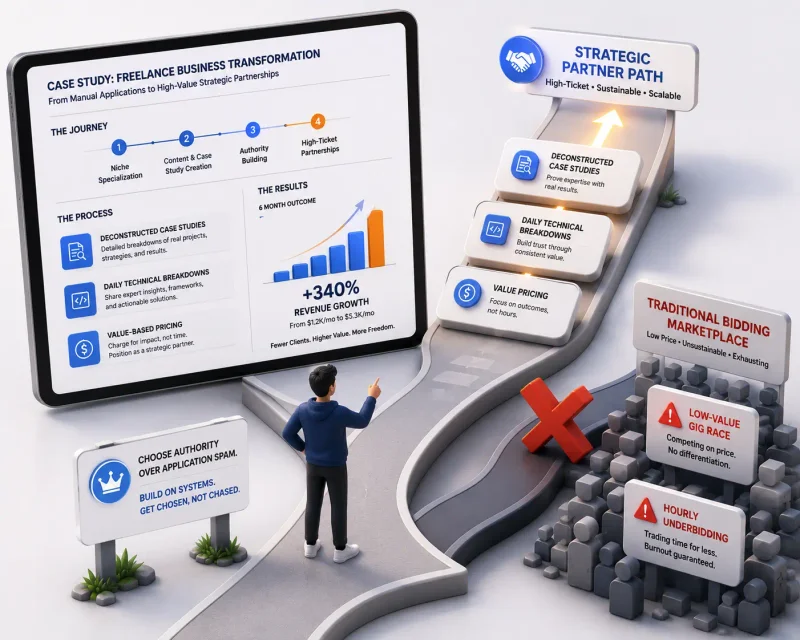
Bidding platforms were built around a race to the bottom by design: dozens of freelancers competing on the same public listing, with price as the most visible differentiator to a client who has no other way to judge quality upfront. That model still exists, but it's gotten worse for freelancers specifically because AI tools have flooded these platforms with faster, cheaper submissions, some AI-assisted, some fully AI-generated, pushing average bid prices down further while client expectations for turnaround speed go up.
A portfolio alone doesn't fix this, because a portfolio on a bidding platform is just one more tab a client has to open among 40 others. It has no context, no story, and no way to demonstrate judgment. It shows finished output, not the thinking that got there, which is exactly the part clients now care about most.
How Generative AI Has Changed Client Expectations of Freelancers
Clients in 2026 have already tried ChatGPT, Claude, or Midjourney for the task they're hiring for, and they know exactly where those tools fall short: generic output, no understanding of their specific audience or constraints, and no accountability when something's wrong. What they're hiring a freelancer for now is the gap AI leaves, strategic judgment, taste, the ability to say "this direction won't work for your audience and here's why," and someone who takes responsibility for the outcome.
This raises the floor on what "good work" means. Delivering a technically correct file isn't differentiating anymore, since a client could often get something technically correct from a free tool. What differentiates a freelancer now is visible proof they can make the calls a tool can't.
Moving from an "Order Taker" to a "Strategic Partner"
An order taker executes exactly what's requested, no more, no less, and gets evaluated purely on speed and price. A strategic partner pushes back on bad briefs, asks about the client's actual goals before starting, and gets paid for the thinking as much as the output. This shift shows up first in how a freelancer talks about their own work publicly. An order-taker's LinkedIn bio says "Graphic Designer | Logos, Branding, Social Media." A strategic partner's bio says something closer to "I help early-stage SaaS founders build a brand identity that gets funded pitch decks taken seriously," because it names a specific client, a specific problem, and an implied outcome.
Defining Your Profitable Freelance Micro-Niche
The Intersection of Skill, Market Demand, and Premium Pricing
A profitable micro-niche sits where three things overlap: something you're genuinely good at, something a specific group of buyers will pay well for, and something narrow enough that you can credibly claim to be one of the better options in that specific lane. Most freelancers only think about the first one. "I'm good at video editing" is a skill, not a niche, because it says nothing about who's buying or why they'd pay a premium.
"I edit long-form podcast episodes into short-form clips for B2B SaaS founders" is narrower, and narrower is what makes premium pricing possible. A generalist video editor competes with every other video editor on price. A specialist in one specific format for one specific buyer competes with almost nobody, because most freelancers never narrow this far.
Narrowing Your Target Audience: Industry vs. Platform Specialization
There are two main ways to narrow: by industry (fintech, healthcare, e-commerce, SaaS) or by platform and format (short-form video for TikTok, email sequences for Shopify stores, technical documentation for developer tools). Industry specialization tends to pay more once established, because you accumulate context about that industry's specific compliance rules, buyer psychology, and jargon that a generalist would need to relearn for every project. Platform specialization tends to be faster to establish, because the skill itself is more visibly demonstrable in a portfolio piece.
Most freelancers do better picking one axis to start, not both at once. "Fintech email marketing for the healthcare industry" is so narrow it may not have enough buyers. Pick industry or format first, prove demand, then narrow the second axis once you have real client data telling you where the money actually is.
Creating Your One-Sentence Freelance Value Proposition
A value proposition should answer three questions in one sentence: who you help, what specific outcome you deliver, and what makes your approach different. A weak version: "I'm a copywriter who writes great sales copy." A stronger version: "I write cold email sequences for B2B SaaS companies that get replies without sounding like a template," because it names the format, the buyer, and the specific pain point (templated, ignorable email) it solves.
Test the sentence by saying it out loud to someone outside your industry. If they immediately understand who should hire you and what problem gets solved, it works. If they respond with "okay, but what do you actually do," it's still too vague.
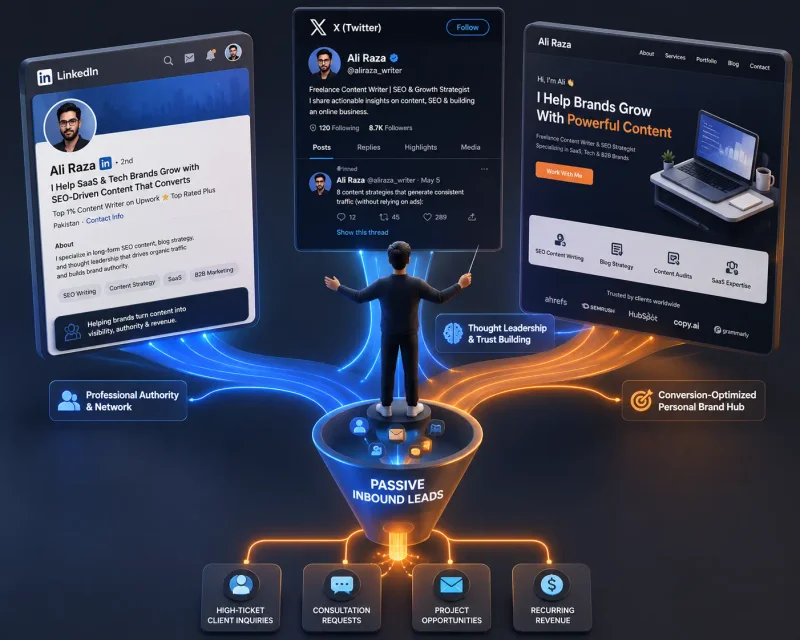
Optimizing Your Core Social Footprint for High-Ticket Client Inbound
LinkedIn Optimization Strategies for Modern Freelancers
LinkedIn remains the strongest inbound channel for B2B freelance work in 2026, largely because it's still where decision-makers, not just other freelancers, spend time professionally. The headline matters more than most freelancers treat it: instead of a job title, use your value proposition directly in the headline field, since that's what shows up in search results and connection requests before anyone opens your full profile.
The featured section should hold two or three specific proof pieces, a case study, a client testimonial with a real name and company, a before-and-after result, not a generic portfolio link. Posting consistently (two to three times a week works better than daily posting that burns out) with specific, opinionated takes on your niche builds far more inbound interest than an optimized-but-silent profile.
Leveraging X (Twitter) and Threads for Industry Authority and Networking
X and Threads work differently from LinkedIn: they reward fast, opinionated, in-the-moment commentary over polished case studies. This is the platform for sharing a hot take on a tool you tested, a mistake you made and what you learned, or a thread breaking down how you approached a specific project. The audience here skews toward other practitioners and founders who are more online and more willing to DM a stranger directly, which makes it a stronger channel for building peer relationships and referral partnerships than for landing large enterprise clients.
Designing a Minimalist, High-Conversion Personal Website Blog
A freelance website in 2026 doesn't need to be elaborate. It needs three things above the fold: a clear statement of who you help and how, one or two proof points (a result, a client name, a number), and a single obvious next step, a contact form or booking link, not five competing calls to action. Every additional page, every extra navigation item, is a chance for a visitor to leave before converting.
A blog on that same site, even a small one, does double duty: it demonstrates expertise to visitors who are still deciding, and it slowly builds organic search traffic for niche-specific terms your ideal client might be searching. It doesn't need frequent posting to work; three or four genuinely useful, specific posts outperform twenty generic ones.
The "Proof of Work" Content Strategy for 2026
Writing Deconstructed Case Studies That Show Process, Not Just Results
A results-only case study says "Grew client's email list from 500 to 5,000 subscribers." A deconstructed case study shows the actual thinking: the starting problem, the two or three approaches considered and why one was picked, the specific tactic that moved the needle, and what didn't work along the way. Here's a real-format example of what that looks like in practice:
Case Study: Cutting a SaaS Client's Trial-to-Paid Drop-off The problem: A project management SaaS client had a healthy signup rate but only 4% of free trial users converted to paid after 14 days. What I ruled out first: The onboarding emails looked fine on the surface, decent open rates around 38%, so the initial assumption (bad email copy) turned out to be wrong. What I found instead: Session recordings showed most users never reached the feature that actually justified the price, a shared team dashboard, because it was buried three clicks deep. The fix: Rewrote the day-2 onboarding email to link directly to that feature with a one-line setup nudge, and moved it into the in-app checklist as step one instead of step four. The result: Trial-to-paid conversion moved from 4% to 9% over the following six weeks, without touching ad spend or pricing.
This format works because it shows judgment, the willingness to rule out the obvious guess, rather than just presenting a number that could plausibly be a lucky coincidence.
Micro-Blogging: Sharing Daily Lessons, Failures, and Technical Breakdowns
Short, frequent posts about a specific lesson, a client mistake, or a technical breakdown build authority faster than occasional polished long-form content, because they show up more often and read as more honest. A post admitting "I priced a retainer too low last year and had to renegotiate three months in, here's what I changed" builds more trust than a highlight-reel post claiming everything always goes smoothly. Clients evaluating freelancers are, on some level, looking for someone who's been through the mistakes already so they don't have to pay for the learning curve themselves.
The Power of Short-Form Video in Explaining Complex Workflows
A 60 to 90 second screen-recorded walkthrough, showing how you actually approach a task, structuring a client brief, debugging a script, laying out a design file, demonstrates competence in a way text alone can't. It doesn't require appearing on camera; a screen recording with voiceover works for most technical or creative freelance niches. This format performs particularly well on LinkedIn and YouTube Shorts, where "how I actually work" content tends to outperform polished, scripted promotional videos because it reads as more credible.
Networking Up: Building Relationships with Premium Global Clients
The Value-First Cold Outreach Framework
Cold outreach that leads with "I'm available for hire, here's my portfolio" gets ignored, because it asks the recipient to do the work of figuring out if you're relevant. Value-first outreach leads with something specific and useful about their business: a genuine observation, a quick audit of one thing they could improve, a relevant example from your own work, before any ask. A working structure: one sentence establishing why you looked at their specific business, one sentence offering a specific, free piece of insight or observation, and a soft, low-pressure close that doesn't demand an immediate yes.
This takes longer per message than mass-sending a template, but the reply rate on five genuinely researched messages usually beats fifty generic ones, and the clients who do reply tend to already see you as useful before the conversation about payment even starts.
Commenting for Visibility: Engaging with Target Client Content Authentically
Consistently leaving specific, substantive comments on posts from your ideal client type, not generic "great post!" comments, but a real addition, a counterpoint, a related example, puts your name in front of that person repeatedly before you ever send a direct message. By the time you do reach out, you're not a stranger; you're someone whose name they've already seen contributing something useful. This works far better as a weekly habit across ten to fifteen target accounts than as an occasional scattershot effort across hundreds.
Partnering with Complementary Freelancers for Cross-Referrals
A copywriter and a web designer, or a video editor and a social media strategist, serve overlapping clients without competing directly, which makes referral partnerships genuinely mutual rather than one-sided. Building two or three of these relationships, formalized enough that you actually refer clients back and forth rather than a vague "let's collaborate sometime," creates a consistent secondary pipeline that doesn't depend on cold outreach or content performance at all.
Monetizing Your Brand: Transitioning from Hourly Rates to Value Pricing
Packaging Services into High-Value Retainers or Productized Offers
Hourly billing caps your income at the number of hours in a day and often punishes efficiency, since getting faster at your work literally means earning less for the same result. A productized offer, a fixed-scope package like "Monthly Content System: 4 blog posts, 2 case studies, and repurposed social copy for $2,500/month," removes that ceiling and makes pricing predictable for both sides. A specialist charging $2,500 to $6,000 a month for a defined retainer scope isn't unusual for freelancers with a proven niche and visible proof of work; the range depends heavily on niche, deliverable complexity, and how differentiated the freelancer's positioning is.
The Psychology of Anchoring Prices Based on Brand Authority
Price anchoring works because buyers rarely evaluate a price in isolation; they compare it to whatever reference point is visible. A freelancer with no visible authority gets anchored against the cheapest options on a bidding platform, often $15 to $50 for a task. A freelancer with a specific niche, a public case study, and testimonials from recognizable companies gets anchored against agencies instead, where the same scope of work might run $5,000 to $15,000. Nothing about the actual skill changed between those two anchors; the visible proof of authority changed which comparison set the client's brain reaches for.
How to Confidently Say No to Low-Budget Projects
Saying no to underpriced work gets easier once you can point to a specific reason beyond "I deserve more," a full calendar, a defined minimum project size, or a waitlist. A direct, non-apologetic response works better than a long justification: "My current minimum for this type of project is $X, and I'm not able to go below that. Happy to refer you to someone earlier in their career if budget is the main constraint." This keeps the door open for future work at the right budget without spending unpaid time negotiating downward, and it signals confidence rather than desperation, which paradoxically makes some clients more willing to meet your rate rather than walk away. Getting clear on this also means recognizing when a "quick small ask" from an existing client is really unpaid scope creep in disguise, and having a standard response ready before it happens, not improvised in the moment.
- How long does it take to see results from personal branding as a beginner freelancer?
- Most freelancers see the first inbound inquiry from content or platform optimization somewhere between one and three months of consistent posting, though real pricing power, the ability to charge noticeably more than before, usually takes four to eight months of visible proof-of-work content. Results depend heavily on niche specificity; a narrower, better-defined niche tends to see traction faster than a broad, generalist positioning.
- Which social media platform is best for freelance personal branding in 2026?
- For most B2B freelance niches, LinkedIn remains the strongest platform for direct client inbound because decision-makers are actively present there. X and Threads work better for building peer relationships and industry authority than for direct client acquisition. The right platform ultimately depends on where your specific target client actually spends time, which is worth confirming before committing significant content effort to any one platform.
- Can I build a personal brand if I am an introvert or don't want to show my face?
- Yes. Written case studies, screen-recorded videos with voiceover instead of on-camera appearances, and text-based micro-blogging all build strong personal brands without requiring a public-facing presence. Proof of work and specific, useful content matter far more to client trust than personal charisma or camera presence.
- Do I need an expensive website to start building my brand as a remote worker?
- No. A simple, single-page site built on a low-cost platform, often under $15 a month including hosting, works fine as long as it clearly states who you help and includes a couple of specific proof points. Clients evaluate the clarity and evidence on the page far more than the design budget behind it.
- How can Pakistani freelancers build trust with premium, high-paying international clients?
- Visible proof of work, detailed case studies, specific results, testimonials naming real companies, does more to establish trust across borders than location ever will, since it lets a client evaluate the work directly instead of relying on assumptions. Being explicit about availability overlap with the client's working hours and payment method flexibility (Payoneer, Wise, direct bank transfer) also removes common friction points that otherwise slow down international hiring decisions.
Action Plan: Your 30-Day Freelance Branding Roadmap
Day 1: Write your one-sentence value proposition using the who-what-how framework from earlier in this guide, then rewrite your LinkedIn headline and bio to match it exactly, replacing any generic job title language.
Day 2: Pull your single best past project and rewrite it as a deconstructed case study following the format shown above, problem, what you ruled out, what you found, the fix, the result, even if the numbers are modest. A specific, honest small result beats a vague impressive-sounding one.
From there, the roadmap follows a simple weekly rhythm through day 30: two to three LinkedIn posts a week mixing micro-lessons and case study excerpts, five genuinely researched value-first outreach messages a week to target clients in your niche, one short-form video breaking down a piece of your actual process, and daily authentic commenting on five to ten target accounts. None of this requires waiting for a bigger portfolio or a slower quarter. It requires publishing the proof you already have and letting the 80/20 principle guide which of these actions gets the bulk of your time once you see which one is actually generating replies.
Related Articles
Explore the Digital Marketing hub →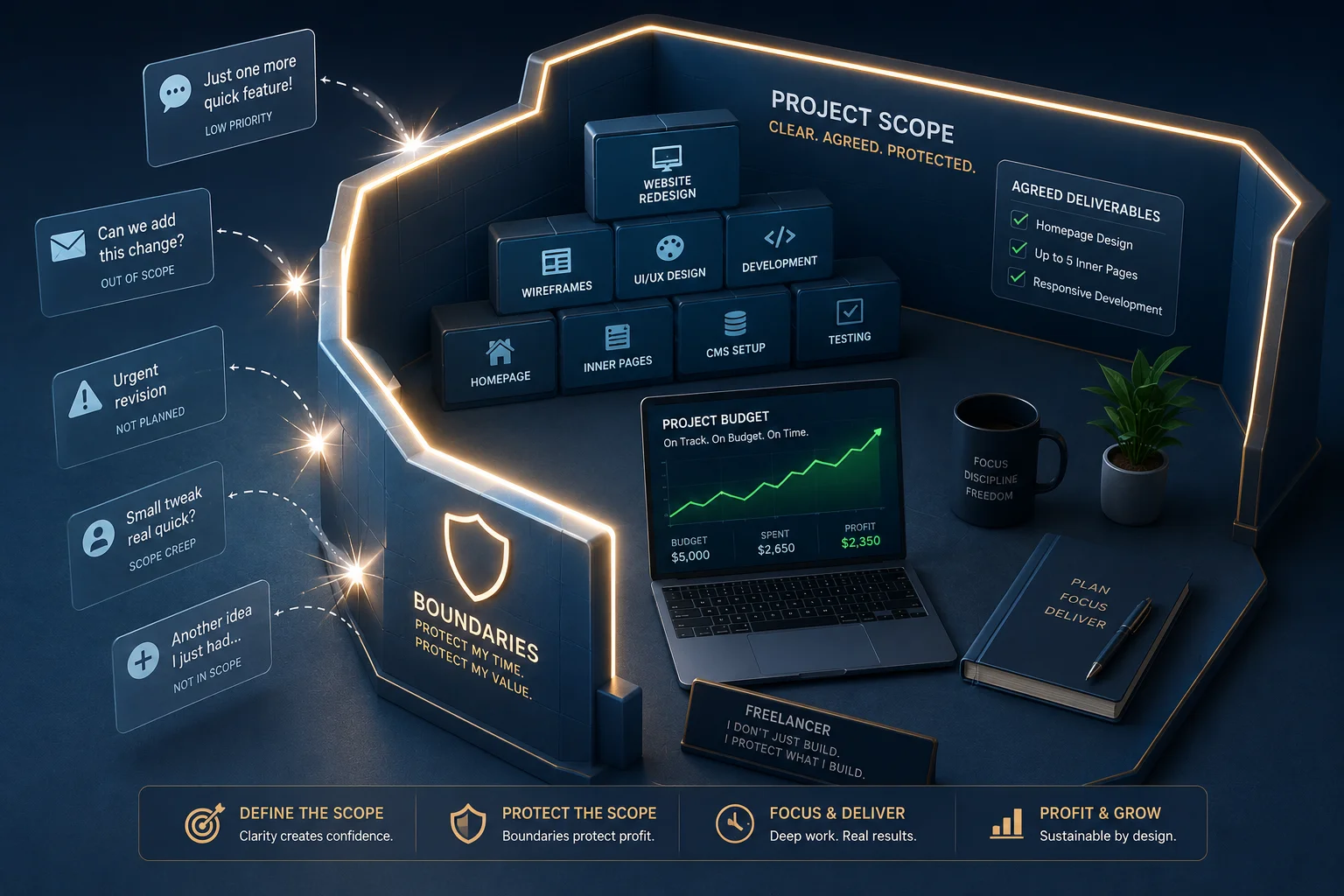
How to Say No to Scope Creep as a Freelancer
A two-week project becomes six weeks one 'quick request' at a time, and most freelancers never see it coming until the invoice doesn't cover the hours.

Organic vs Paid Social Media Strategy on a Budget
Fifty dollars can't buy you everything, but spent right, it can buy you clarity.
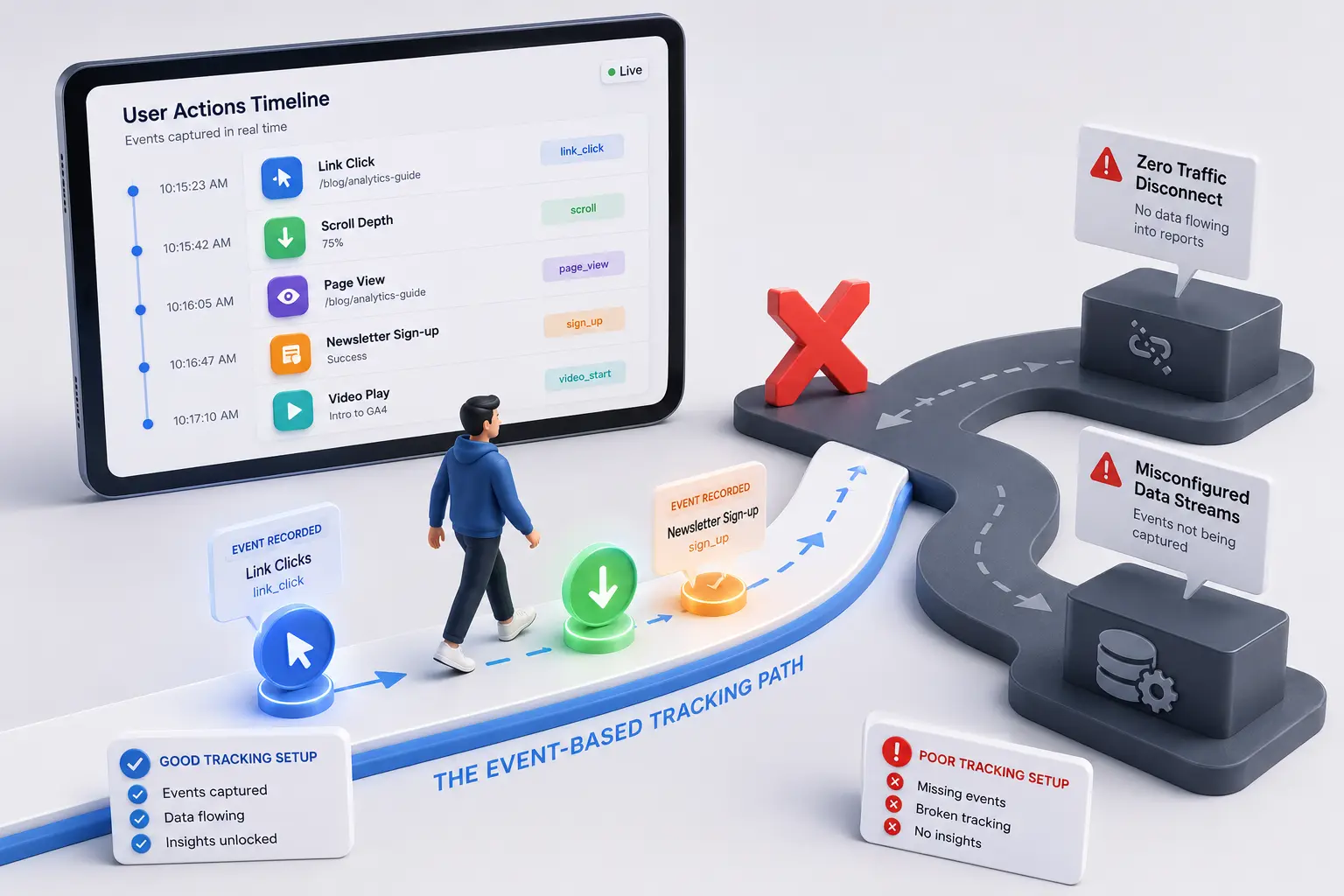
How to Read Google Analytics 4: A Beginner Guide
GA4 looks like a foreign language until you know where the numbers actually live.